Creating small flecks of white in your watercolours

I’ve been away in south-east England last week, and for two of the days working on the stage-by-stage paintings for my next book, Winter Landscapes in Watercolour at the Search Press studio. One of those awkward little problems facing the watercolourist is when you need to include small spots or lines of white in a scene, a particular necessity with snow subjects.
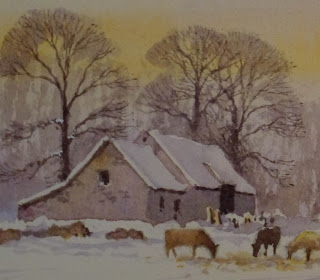
Snow scene

You can try masking fluid, but this often induces larger blobs than you want and can sometimes look wrong when it is rubbed off. Scratching with a scalpel is another method, and this can be very effective, though not everyone is confident with using one. In this scene showing part of a painting I have painted on white gouache where I wanted patches of snow on the upper side of branches close to the trunk, where they tend to remain longer as there is less motion in that part of the branch. I’ve also dabbed some on the window sill of the barn. The roofs were left white, and you can see that because the sun is so low the tops of the roofs are slightly darker in shadow than the strips at the end where the snow is quite thick. I often use white gouache for tiny areas like the branches and sills.

The book will be published by Search Press in September, and will be accompanied by a DVD from APV Films. As well as winter landscapes it will cover late autumn to early spring, covering a wide variety of scenery and techniques. It is the third in the series, following Mountains & Moorlands in Watercolour and Skies, Light & Atmosphere in Watercolour, both of which are available on my website

Painting snowy landscapes

At last, real winter has arrived, and for the landscape artist having the countryside cloaked in deep snow is a great inducement to get out and capture some new scenes, even if you can’t stand the cold for long and have to rely on the camera. I’ve just returned from an extremely rewarding trip to North Staffordshire where we did some filming for a DVD on winter landscapes. Snow simplifies the landscape considerably, making it easier for the artist.

In this view on the North Staffordshire Moorlands I selected a back-lit angle by choosing mid-afternoon to visit the spot – back-lighting tends to add drama to a scene, and lose detail in more distant features. The road acts as a good lead-in and the right-hand electricity pole breaks up the far ridge, so it might be worth leaving in. One of the cows in the middle distance (left) is looking out of the picture, so I would turn her round to look at the house. After I’d finished the sketch the chimney on the left-hand building started to emit smoke, so I then adjusted the sketch to include smoke, but had it emerging from the right-hand house, which was my centre of interest.

My first painting course this year is at the Caer Beris Manor Hotel in Builth Wells, Mid Wales from the 7th to 12th April, and there are still a few places left. The gentle, rolling landscapes provide a wealth of subjects, with the more dramatic Brecon Beacons to the south, so there is something for most tastes, and plenty of interest for non-painting partners. Although it is primarily for watercolourists, Jenny will be on hand to demonstrate pastel landscapes as well as offering tuition in the medium. You can check it out on our website, or telephone the hotel on 01982 552601, or email them at info@caerberis.com