We’ve just finished the studio filming with APV Films for my forthcoming DVD on painting Winter Landscapes, due out in September with my book of the same title. Most of the filming went smoothly, although the last part was heavily punctuated by wild gusts of wind and heavy rain lashing the studio, accompanied by a bombardment of artillery fire from the Sennybridge range. Thankfully they were not firing at us! It rather reminds me of the time I was sketching and camping on a Northumberland bombing range, having missed the signs somehow……….
At the moment I’m working on Wild Highlands, an exhibition in conjunction with the John Muir Trust, which will run from 16th April to 18th June in Pitlochry, Scotland. One of the aims of the exhibition is to highlight the ongoing devastation of the Scottish Highlands by industrialisation by massed wind turbines and their supporting power lines, which are now encroaching on some of the stunning mountain landscapes that epitomise the Highlands. Many of these will be on peat blankets and former forestry areas, which are the closest equivalent we have in the UK to rain-forests.
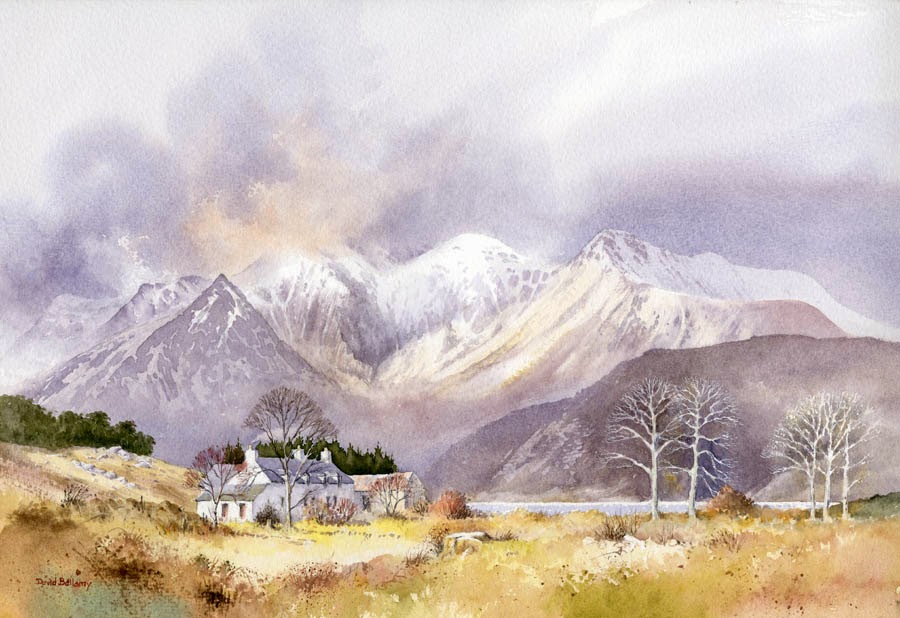
This painting of Beinn Eighe will be in the exhibition, and you can see that the mountain has several summits. Painting all these in good weather can invoke a feeling of having too many summits, so this is where it’s often a good idea to bring in some bad weather to hide one or two. It also adds a sense of mystery, which viewers love. I usually achieve this effect of mountains hidden in clouds by running the mountain washes up into a wet area in the sky – in this instance where you can see the pink effect. An alternative technique is to soften off the mountain peak with a wet sponge.
As you can see here, I’ve actually made my ‘bad weather’ rather more user-friendly by painting with alizarin crimson and French ultramarine mixed with cadmium red, so make sure you utilise the right brand of ‘bad weather!’
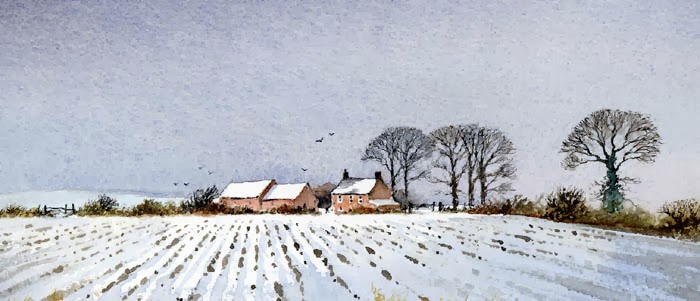
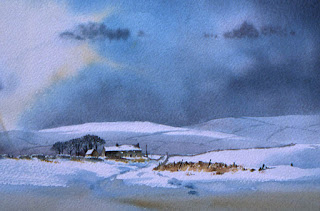 This watercolour shows a lonely farm on Tideswell Moor in Derbyshire, where you can find many similar compositions, at times without even needing to get out of your car! While it’s tempting to think of snow as being white, the snow as we see it varies considerably in tone, sometimes appearing almost black when in deep shadow and backlit by strong sunshine. If you wish to push a snowy hill or mountain back into the distance lay a weak wash of blue or blue-grey over it, as you can see on the right-hand distant hill where I used cobalt blue. By comparison the left-hand hill, which is simply the white of the paper, really does come forward. To accentuate the white roof I’ve set it against a mid-tone background: planning your tones like this is easy with some forethought before starting to paint.