David Bellamy – Sketch-notes

Last week I did a watercolour demonstration for Hythe Art Society in Kent. It was their 50th anniversary and the event was held in the baronial hall of Lympne Castle, a grand place with marvellous views across to the French coast. It was followed by a splendid cream tea – a most enjoyable occasion, and what a lovely art society! May their next 50 years be a great success.

Naturally I was keen on taking the opportunity while on the Kent coast to do some sketching, and though there was not much time I managed a quick pencil sketch of the fishermen’s beach at Hythe.

The fishing boats were backed by a couple of the old Martello towers that run along the coast, thus giving it a touch of local flavour. As you can see, I included quite a few written notes on the sketch to remind me not just of colours, but any other useful information such as the uniform level of the base of the clouds which was very marked and the whole revealing an obvious diminution in the size of the clouds as they receded into the distance. Tonal values were also important with the main shadow area over the closer tower, so I have emphasised this. Notes on observations can be of enormous help to the artist, and even if you are not sketching it is worthwhile keeping a notebook in your purse or pocket to add to any photographs you may take. Sadly the fishermen’s livelihood is now threatened by building taking place to the right of the picture.
Next week I shall be demonstrating at the Patchings Art Festival in lovely countryside just north of Nottingham. My appearances will be at 1pm on Thursday 4th, 1pm on Friday 5th, and 11am on Saturday 6th, with each demo lasting around one hour, so do come along if you are attending the festival. I shall be using the brilliant Saunders Waterford High-white papers made by St Cuthberts Mill. Hope to see you there!

Jenny Keal – Sketching in Kent

David and I have just returned from a trip to Kent where David did a demonstration for Hythe Art Society at the stunningly beautiful Lympne Castle, overlooking Romney Marsh, to celebrate their 50th Anniversary. We were made very welcome by this warm and friendly art group and shared their celebration tea with them after the demonstration.

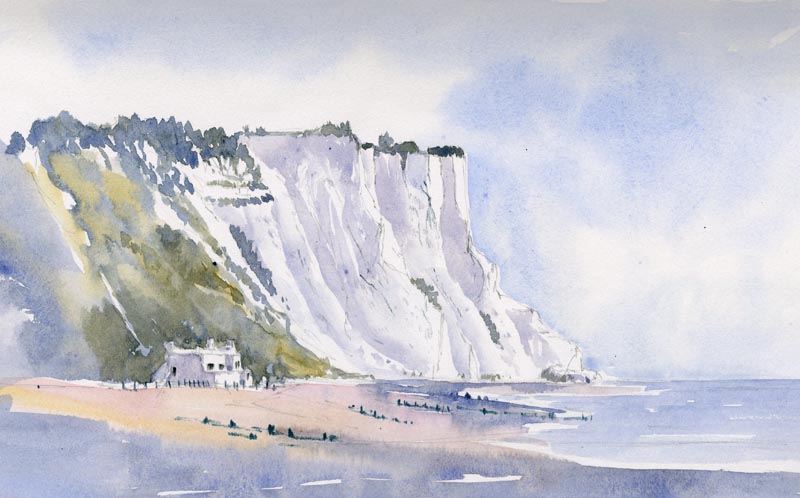
We took the opportunity whilst in this beautiful corner of England to explore Dover Castle, Folkstone Harbour and St Margaret’s at Cliffe, which yielded numerous sketching subjects. The weather was beautiful as we sketched the White Cliffs of Dover in the hazy sunshine.

white cliffs sm

White Cliffs of Dover, St Margaret’s at Cliffe, sketch by Jenny Keal

I know I’ve said it before but I can’t emphasis enough how important sketching out of doors is to improve your painting. The watercolour sketch above only took about 30 minutes to complete. Working in a hardback cartridge paper sketchbook, with a slight breeze to dry the washes, I was aiming to capture the freshness of the morning and the delicate quality of the light. Leaving out lots of foreground detail to retain the freshness I was aiming for.

db kent 006

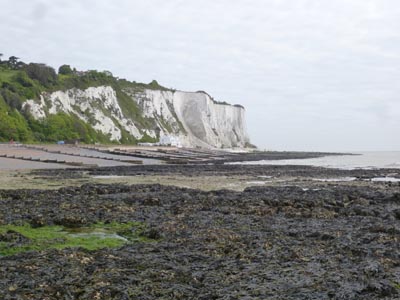
Photograph, St Margaret’s at Cliffe

So often a sketch can capture something that is lacking in a finished painting, and working purely from a photograph can rarely portray the magic of a place. When I look at the sketch I can smell the sea, but not when I look at the photograph.

David Bellamy – Granulating Watercolours

It’s always a pleasure to try something new. As artists we are constantly being bombarded with new products and it is easy to find ourselves overloaded with stuff we will rarely use. When it comes to colours it pays to check them out first: if they are new colours seek out reviews. Check out their permanency. How do they differ from what you already possess? Buy only a few at a time and get to know them well before taking on any more. See how well they mix.

 One feature I love about watercolour paints is the manner in which some colours granulate. In the Daniel Smith range quite a number of the colours granulate beautifully. Here you can see the stunning granulation of Zoisite Genuine, an interesting grey with which you can create dramatic washes, and on the right some German greenish raw umber which is excellent for vegetation and foliage. Whilst you can introduce granulating medium into your colours, it does need copious amounts, but the colours shown on the right really do sing out with a lovely sense of textures. Check the labels for those that granulate and give one or two a try before committing yourself further.

This example was painted on Saunders Waterford rough paper – if you use a rough paper it will enhance any granulation effects. I shall be demonstrating at the Patchings Art Festival in Nottinghamshire on 4th, 5th and 6th June, so do come along and see us in the St Cuthberts Celebrity Marquee. It’s also a great place to look out for some new colours.

Jenny Keal – Atmosphere and Recession

Learning how to create atmosphere and recession in a landscape painting is an essential skill for a landscape artist. Artists will have their own techniques to achieve this effect but in my new DVD Pastel Demonstration Lingcove Bridge, I explain my methods. I like to give a painting a sense of space and a strong feeling of atmosphere.

lingcove bridge 2

My favourite techniques for creating recession are through the use of colour, tone and detail. Cooler, paler colours in the distance: warmer, darker colours as you progress towards the foreground. Less detail in the background and more in the foreground, especially around the focal point.  The relative sizes of objects in the landscape is also a consideration. Trees in the distance, even if they are larger than foreground trees, need to be depicted as smaller. As Father Ted says, “this cow is small but those are far away”

Atmosphere is something that becomes easier to understand if you sketch outdoors, in front of your subject. There is nothing like getting out in the countryside to give authenticity to your landscape paintings.

These are not new ideas, the old masters excelled at giving a sense of depth through these methods. You almost certainly have heard these tips before, but it can’t be said too often.

The new DVD is 1 hour 23 minutes long and is filmed in close detail so you can see every mark I make, with a running commentary about my thought process. There is an excerpt on You Tube

David Bellamy – Painting rough ground in watercolour

My work tends to gravitate to those places I love most – the mountains, the wild coast and remote places where nature is supreme, where the ground is generally pretty rough. Capturing this roughness in a painting can be very rewarding, and as rough ground is not found only in the wild areas it pays to be able to render this effectively.

In this watercolour of a barn on the Isle of Skye rough terrain dominates the scene. I chose Saunders Waterford rough 140-lb paper which works so beautifully when you wish to create these fascinating rough textures, and effectively does half the work for you. With the highest mountain I began with an overall wash of Cobalt blue, bringing in some yellow ochre near the bottom in a soft graduation. When all this was dry I then used a stronger mixture of the blue with little water on the brush, dragging it down in the direction of the slope to produce an overlaid wash of broken colour which allowed some of the previous wash to show through, thus creating the appearance of rough ground on the mountainside. I employed the same technique on the warm-coloured left-hand hill, making the contrast between the first and second applications much stronger than those on the mountain because the hill is so much closer. In front of the barn I’ve used a combination of drybrush and dabbing on a warm colour to suggest the rough grasses, over an initial wash of Naples yellow. You can apply this broken colour technique in many situations, but for rough terrain it is ideal.

This painting will be displayed in my forthcoming exhibition at the Windrush Gallery in Windrush, Gloucestershire OX18 4TU  Tel. 01451 844425 from Sunday 3rd to Sunday 10th May. Please note it will be limited opening on 7th and 8th May during a workshop. Opening hours are from 11am to 5pm The exhibition covers a wide range of subjects, including mountain, marine, pastoral and several overseas paintings.