David Bellamy – The Magic of Backlighting

I have to confess that I’ve neglected this blog lately as I’ve been away enjoying the highlands of Scotland in one of the most beautiful periods of sunshine. As well as climbing some of the peaks I also found myself drawn towards the stunning coastline, and with a combination of light mist and strong sunshine, day after day brought heavenly opportunities for the landscape artist.
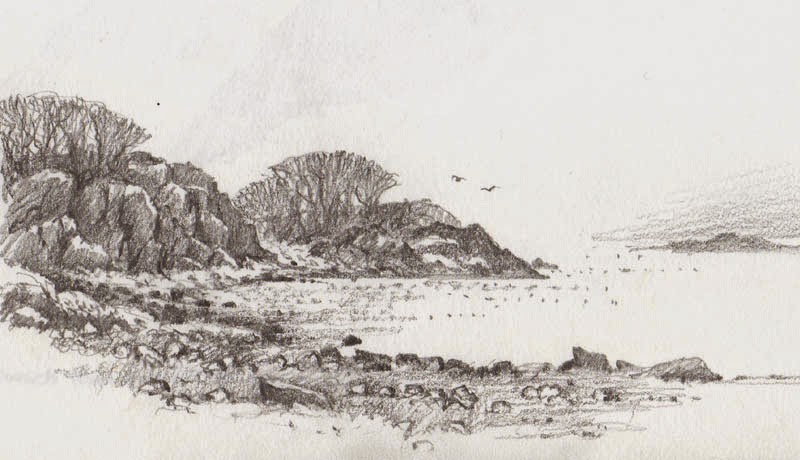
One of the sketches I did was of the rugged west coast as shown on the right. Here I used a 5B pencil on a cartridge pad. Most of the horizon was lost in mist, so I only hinted at it on the right. With the sun providing such strong backlighting the rocks stood out dark, with their tops catching the light, as were the areas of beach. For the sparkling water I have simply dotted the area in question, and this can be moved to suit my needs when I carry out the final painting.

A scene like this can look a little desolate without some form of life, so I would introduce bird life or maybe a small boat into a painting. A cormorant stood on a rocky promontory well to the right, and in a nearby beach a number of waders were at work on the wet sand so it would be easy enough to introduce any of these to this scene, perhaps with a strip of sand in the case of the waders. The sand would also break up the monotony of wall-to-wall stones and pebbles in the foreground.

I enjoyed every moment I lingered in this delightful spot. Nature washes away all the stresses of life, and for me always injects a tremendous energy into my work. If you go out into the landscape it will always have a lesson for you, without fail. As someone with a deep love for the natural environment I have always treasured my visits to the Highlands, but for how much longer I don’t know. With the encroach of massed wind turbines across some of Scotland’s most iconic landscapes they will before long be submerged in a ghastly industrial mess. Even if the turbines were effective and didn’t involve highly toxic manufacture, didn’t decimate the bat and raptor population, didn’t pose a considerable threat to human health, they should still be kept out of these overwhelmingly beautiful landscapes for which Scotland is (at the moment) world-renowned. As they are primarily a means of making vast profits for corporations, political parties and even many so-called ‘green’ organisations, it is little short of criminal what is happening in Scotland and Wales. Please go and see these marvellous landscapes before they are decimated, and see for yourself what is happening to one of the most beautiful countries in the world.
David Bellamy – In Praise of the Tea-Pot

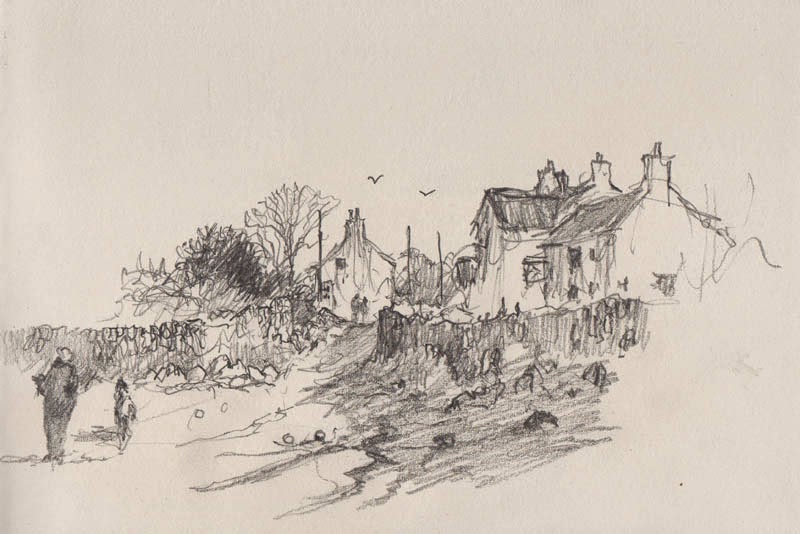
Maintaining morale when out sketching on location is vital, and while some might find a whisky flask useful, I generally rely on tea. Sadly last week in Pembrokeshire the cottage where I stayed lacked that vital ingredient, the teapot. Naturally, this was pretty disastrous, so when out and about I made the most of any such facilities. In the sketch below the right-hand building is a superb tea-shop selling the most delicious cakes, and this is why you might detect a certain hastiness in the rendering of the pencil-work.

However hasty we may be in sketching, it pays to consider the composition carefully when creating a painting from the sketch or photograph. Unless the subject is quite a simple affair I normally carry out an intermediate studio sketch to work out where I wish to place the important elements and the main emphasis, together with the sort of atmosphere I wish to convey. In this instance I would move the composition to the right a little so that the left-hand house did not appear in the centre of the composition, as this would be my centre of interest. I would need more detail to be included above the left-hand wall and figures (detail missed because of the urgency of the tea situation), so I would have to resort to memory, a photograph, or the good old imagination. The main figures would be placed further to the right, a little closer to the centre of interest, and I would make full use of the dark runnels of water descending from the centre right – I have already bent them slightly to come towards the viewer as a lead-in. These are the kind of thought processes that go through my mind before I begin the painting.

Don’t underestimate the value of tea for the artist. I’ve even used it on a painting outdoors on occasion. Last autumn while I was running a landscape painting course a lovely German lady was painting a cottage, which filled her paper. When I asked her what was her focal point she replied, “The tea-pot.” Sure enough, there was a teapot in the window. Such observations may not only bring a smile to your viewers, but might also result in a sale.

David Bellamy – Painting misty mountains in watercolour

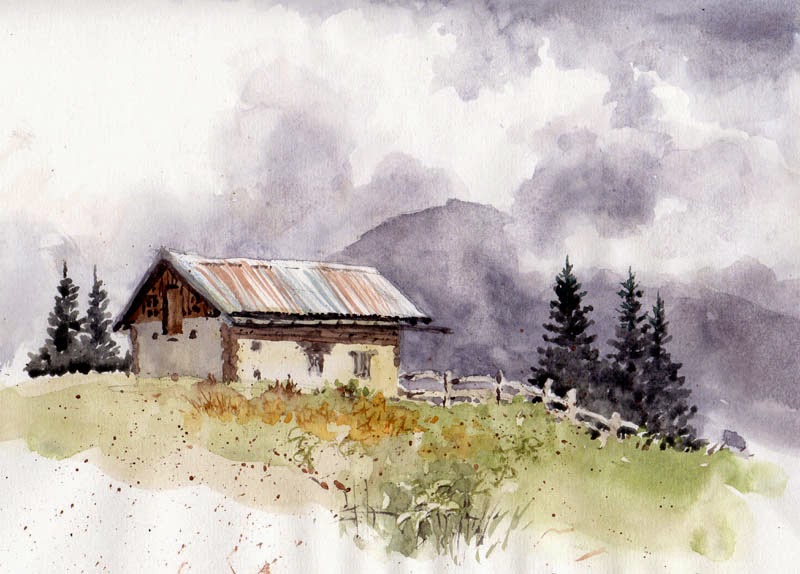
Jenny and I have just returned from Austria where we took a group to paint Alpine scenery. It was a great trip, with many memorable scenes, despite rather a lot of cloud and mist. So we had rather a lot of practice in rendering misty mountains in watercolour!

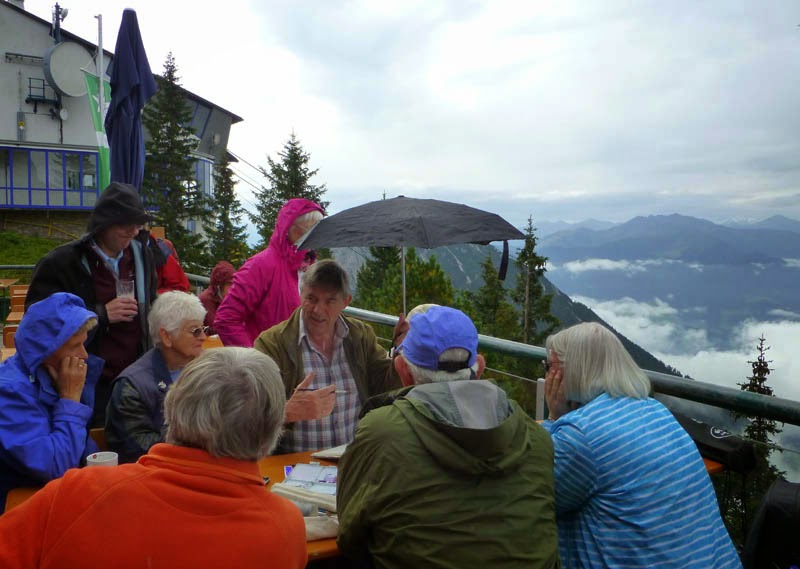
Here I’m doing a watercolour demonstration way above the clouds, with marvellous views all round as the mountains rise out of the inversion. Alas, there were even more clouds above us, so we did get a little rain near the end of the demo, but not enough to spoil things. A cappuccino and an apple-strudel quickly restored morale.

Mist on mountains can, for the artist, sometimes be both magical and a misery. I love the way it can blot out unwanted features, but as we all know, it often blots out the very features we want to see!

There are a number of ways of creating mist in watercolour. In this scene above the Inn Valley in Austria I ran colour into wet areas to create soft edges to the clouds. I had to work quickly as I was painting on a cartridge book. With such a lot of cloud edges, inevitably some dry hard-edged before they can be corrected.

This is not usually a problem as they can later be softened with a damp brush when the paper is completely dry, though the odd hard edge here and there might well enhance the clouds.

Alternatively a soft sponge is an excellent tool for softening off, but take care if you use cartridge paper as it won’t stand too much surface friction. Enjoy your clouds!

Jenny Keal – Sketchbooks

sketchbooks 001

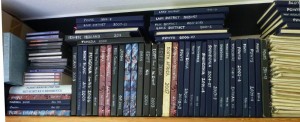
Here is just a fraction of David’s many sketchbooks

I recently had an email inquiring about which sketchbooks I recommend. I thought other artists would find this useful too, so I am sharing this information here.

David and I both have a large collections of sketchbooks, The UK ones are dedicated to certain counties, or regions such as Mid Wales, Lake District, Yorkshire etc. and the overseas ones are illustrated daily journals of the trip, with text and drawings and paintings.

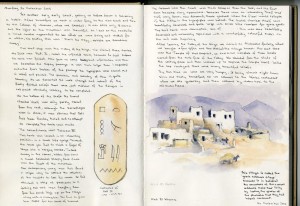
egypt sb

A page from my Egypt sketchbook

We have used a number of different brands over the years, some of which are no longer available but the ones we currently use are Daler Rowney Ebony Hardback Sketchbooks  in either A5 or A4 sizes. Many of the UK ones and all of the overseas ones are in casebound hardback sketchbooks with cartridge paper, either A4 or A5. Casebound books are more durable than ring bound ones and have the advantage that you can write on the spine and then organise them on a bookshelf.

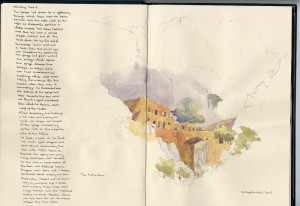
crete sb

A page from my Crete sketchbook

 The other advantage of a casebound book is that you can extend the sketch over a double page spread and with an A4 sketchbook that means you have an area A3 in size. The paper weight is also important if you intend to use watercolour in your sketches. I would say that 150 gsm cartridge paper is the minimum weight to look for. There are a number of casebound sketchbooks coming onto the market and not always in art shops, some stationery shops now seem to stock plain cartridge paper casebound books. but check the paper weight carefully before you buy.
David and I strongly believe that sketching out of doors is the best way to improve your artwork, and if you paint in watercolour then sketching in watercolour out of doors is a truly liberating and exciting experience and will almost certainly improve your studio watercolours.
I hope you can discover the pleasure of working out of doors in front of nature.

Sketching mist streams in the Canadian Rockies

I’ve not long returned from a trip to the Canadian Rockies, where the mountains rise high in truly awesome splendour. I managed around a hundred sketches, many in watercolour, and the hot, sunny weather made it really a pleasure to be out sketching. Luckily I had some bad-weather days as well, even some snowfall, and this gave my work that added atmosphere: when you can see everything there is no mystery.

Canadian Rockies

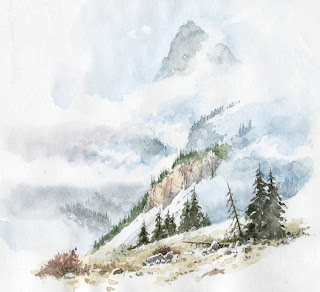
This watercolour of Stoney Squaw Mountain near Banff was done on a cartridge sketchbook, showing fresh snow and wreaths of mist, which many find difficult to tackle. If you use copious amounts of water and keep your edges soft (sometimes you need to soften edges that have dried hard with a damp brush). Obviously experience with the wet-into-wet technique helps here, and you may well need to re-wet some areas to create misty shapes of crags, trees and ridges.

One of the great advantages of the colour sketch over a photograph in a situation like this is that you usually find the camera will record simply stark contrasts of dark rock and white snow, losing any sense of colour, unless strong light is highlighting  any colour. When sketching, observe carefully any colour present in rocks and vegetation, even exaggerating it if necessary, to avoid the work looking too cold or sombre.

I can’t wait to get going on some enormous compositions of the Canadian scenes.