
DAVID BELLAMY GLAZING A WATERCOLOUR FOR ATMOSPHERE

Featured

The glazing technique is an extremely powerful way of creating atmosphere in your landscapes, and is a method I use regularly. This involves laying a transparent or semi-transparent wash of watercolour over part of a painting that has already been painted. You need to ensure that the paper is completely dry before laying on the glaze, although if you are very experienced you can on occasion get away with laying it on a damp surface, although it is easy to end up with a mess in that case!

This is a watercolour sketch of a scene high up in the Sundance Mountains in the Canadian Rockies, painted in a cartridge A4 sketch-book, and is almost a monochrome. Throughout I’ve used a mixture of French ultramarine and cadmium red in various strengths of tone, firstly laying on a wash of a light version and when this had dried applying detail with a darker tone of the same mix to indicate the shadow areas on the peaks. When all the background detail had been painted I waited till it dried and then applied a glaze of the same mixture only making this darker above the large boulders and lightening it as it crept up the face of the far mountain. This softened some of the lower detail and created a sense of misty atmosphere in the valley below. I then completed the foreground detail on rocks and trees. This scene is featured in my Watercolour and Beyond book published by Search Press. It is packed with watercolour techniques and methods to enhance your paintings.

The glaze method can be used on all types of landscape, not just mountain scenery, and limiting the colours in this way further enhances the mood. With sharp contrasts in the foreground the sense of misty atmosphere is further enhanced. The technique is also great for warming up or cooling down a passage in your composition, or if you wish to highlight a particular part of it, such as a building, summit or other feature.

One extremely effective tip is to try this method out on an old watercolour, perhaps one that hasn’t really worked for you, so dig out some of you old painting and have some wonderfully experimental moments with them.

DAVID BELLAMY ADDING SUPER-TEXTURE TO YOUR WATERCOLOURS

Next month, my new book, Watercolour and Beyond is published by Search Press. It’s quite different from my earlier books in that although it begins with traditional techniques it is mainly concerned with introducing new methods to watercolour landscape painting. One example shows how to use masking fluid not just for masking out intricate details, but to employ it in a much more creative manner. Or producing delightful effects by stamping with cosmetic sponges and variegated colours. Super-granulating colours can achieve spectacular passages in your work, and by introducing non-art materials into your landscape compositions your can add a new dimension. There are also ideas for various projects, some of which don’t involve creating wall-hung art, but give you alternatives for your work.

The painting I have chosen as an example from the book shows how a foreground can be embellished with Daniel Smith Watercolour Ground, which is rather like gesso in consistency, but it will happily take your watercolour washes. I have cut out a large part of the composition so that it’s easier for you to see the amazing textural effects you can achieve with this method.
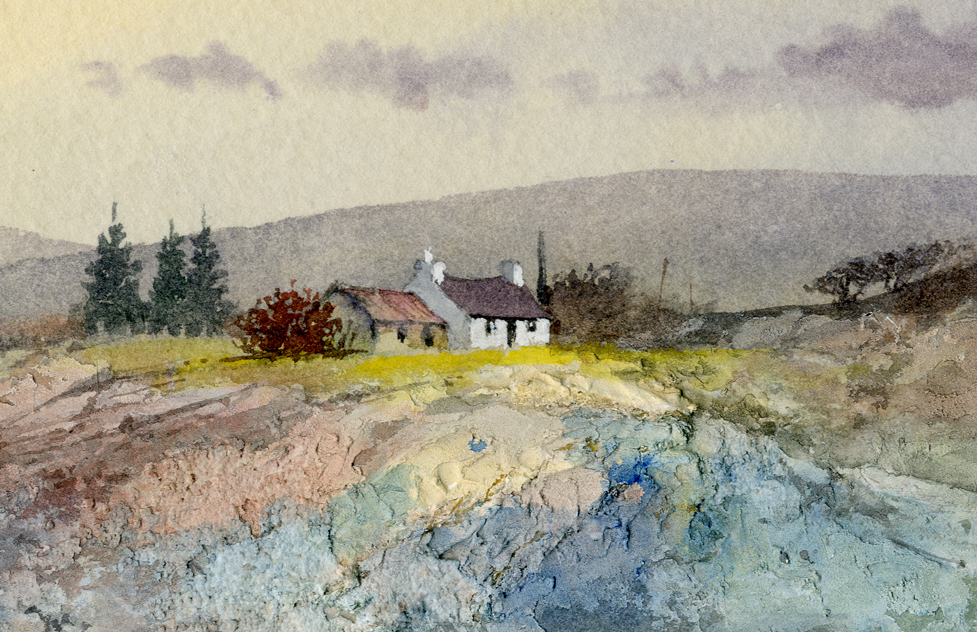
To suggest the rough foreground Daniel Smith Watercolour Ground was laid on with a painting knife a couple of days before beginning the painting, and in the final stages I laid washes of Naples yellow, potters pink and pthalo blue over the watercolour ground, merging them all in while they were still wet. The ground is especially effective in rendering rocks, cliffs, rough walls, mountainsides, river banks and many other landscape features.

One of the main aims in writing Watercolour and Beyond was to encourage experimentation and bring a sense of joy into painting. Whether you paint full-time or just now and then you will find the techniques and ideas crammed into its pages will give you plenty of inspiration and a wonderful feeling of trying something new in your painting. We no longer have a mail-order shop, but of course you can get the book direct from www.searchpress.com or from your local bookshop.

On Saturday 3rd May the Erwood Station Landscape Artist of the Year competition gets under way with the first heat. There will be one heat each month throughout the summer, and if you wish to participate you can get information at 01982 560555. It is a great place to spend the day painting with others, and is a great learning experience. I shall be one of the judges during the first heat, so maybe I’ll see you there.

DAVID BELLAMY HAPPY CHRISTMAS

I don’t know about you, but I find December is always a mad and chaotic rush around trying to keep normal life and business functioning while coping with the extra tasks of Christmas. I’ve just returned from town whtere I found the toy shop far more interesting for buying presents than the adult ones!

This scene I came across while stumbling through the snow-bound woods near the Bachhowy River a short distance from home. That was a long time ago and the cottage was abandoned, but to give it a sense of life I added rising smoke. The sky is mainly quinacridone Sienna and moonglow, with some touches of French ultramarine. I used masking fluid to reserve the snow-laden branches. The scene was more or less as I have created it, complete with puddle in the foreground, although I have changed the sky considerably.

I shall be enjoying a far from relaxing Christmas in the company of my rather energetic little grand-daughters in Pembrokeshire, but I’m sure we’ll have a great time, and I wish you all a very Happy Christmas and good health and much success with your creative activities in the New Year.

David Bellamy – Looking into Fierce Light

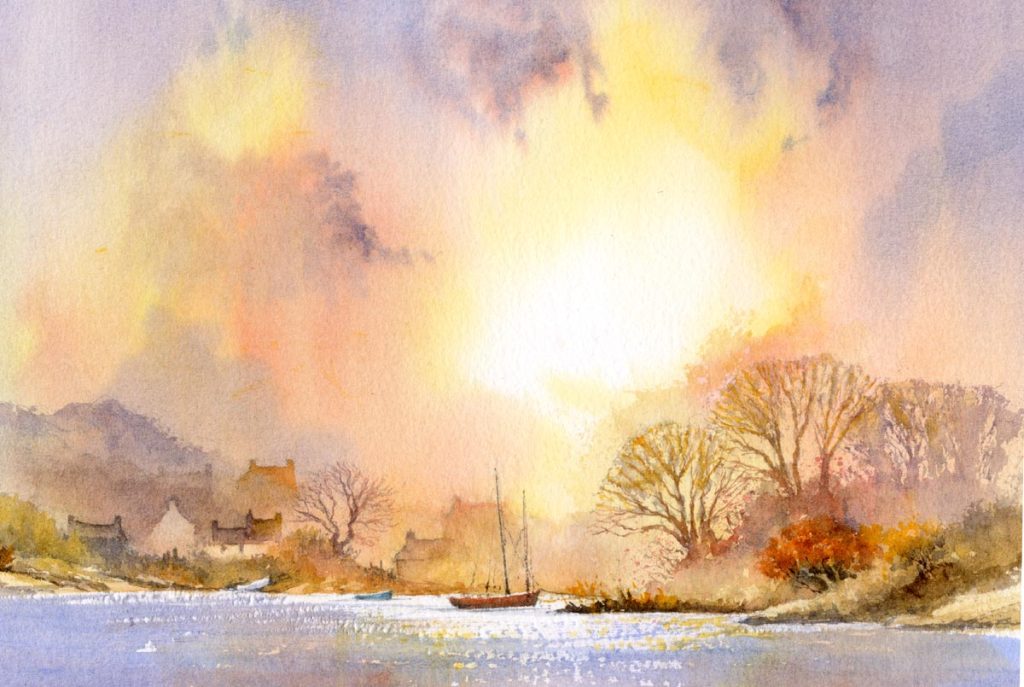
Strong evening or early morning light, when it is low on the horizon, can produce some powerful atmospheric effects, such as losing detail, creating a dynamic sense of drama and changing the actual colours of various features. However, it’s not always easy to look into fierce sunlight and observe the scene for any length of time, even with sunglasses. Taking a series of photos, each with a different aperture setting can reap rewards, but if you are able to quickly capture the essential elements of the scene with a colour medium, so much the better. Watercolour pencils can be very effective for this, as watercolour paints can be quite a challenge in such fastly-changing effects.

Evening light, Llangwm

In this painting carried out on Waterford 300lb NOT paper I created the light area in the sky with Naples yellow around a white spot and then introduced quinacridone gold and permanent alizaring crimson. Working quickly I brought in washes of weak French ultramarine, in places mixed with cadmium red for the stronger wisps of cloud. These wisps were applied with a large swordliner brush. After allowing the paper to dry I painted in detail of trees and buildings with mixtures or French ultramarine and cadmium red in various strengths, sometimes with hardly any ultramarine. Aussie red gold also enlivened things up in places, particularly the right-hand bush.

By leaving out certain details like one end of a building on the sunlit side, the sense of mood is increased, with the colours becoming cooler the further away they are from the centre of the light. You may well have existing photos that can be used to create a work of this nature, but do take care when looking into fierce sunlight and wear dark sunglasses to protect your eyes. Avoid staring directly into the sun.

Well, Christmas is upon us once more, and hopefully you will find some artistic present in your stocking! Have a great Christmas and I wish you every success with your paintings in 2024, and good health.

David Bellamy – Painting the Wye

It’s been some time since I last created a blog post – the problem has been that the Blogspot blogging software appears to have been crapulated by the blogging company without warning or providing any idea of how to fix it. The pictures simply appear as a string of incomprehensible characters, which of course, is not what you would want to see. Additionally I have been away from home a lot this summer, but now we’re trying to fix it.

The image I have before me is an 8-line string of characters, but I am hoping that the resulting image on your screens will be a watercolour of the River Wye in Summer. The mountain and water have been kept simple, the more distant water a horizontal sweep of cobalt blue with very little water on the brush, softening down into a light area, with some dark reflections introduced at the sides. The dark tones on the closer trees suggest the impression of distance in the composition. I have over-done the foreground flower collection a bit, but sometimes it is interesting to include strong detail in the foreground when most of the composition is quite simple. The painting will be part of a small exhibition at Erwood Station Gallery & Craft Centre, which lies a few miles south of Builth Wells in Powys. It starts on Saturday 23rd September and runs until 15th October, every day. I shall be giving a demonstration of painting the Wye in watercolour on Monday 25th September at 7pm, admission by ticket only because of limited space. Telephone 01982 560555 for the Centre. More details with the next blog which hopefully will have all the problems resolved, although at the moment I’m more inclined to believe in magic than these software geeks!