Painting undergrowth and other thorny problems

When it comes to undergrowth we can quite literally find ourselves with quite a thorny problem, and painting it seems no easier: how do you cope with all those similar, repetitive and often mundane shapes? Firstly, don’t dismiss those mundane bits of a scene: in a composition we need quiet, mundane passages in order to make the exciting bits stand out, so they are important parts of a painting. Secondly, when you are out in the countryside don’t forget to gather material like this for use in a painting, in sketch and photographic form. Now and again concentrate on these less dramatic features and deliberately record them carefully.

This photograph taken on Strumble Head in gentle spring sunshine will give you an idea of what I mean by recording the less dramatic. Posts, boulders, a dry-stone wall can break up the mass of undergrowth, as can a gate, tree, bush, rusty farm machinery, and so on. The undergrowth serves the extremely useful purpose of creating a lost-and-found effect here for the wall, which can look too strident if standing up above the ground by itself.

Of course the wild tangle of vegetation needs simplification by reducing it to fewer detailed shapes. Make some of the grasses and briars stand out more than others. With vegetation the spatter technique of splashing blobs of paint from a brush can work very effectively. If you wish to beef it up, as you will do from time to time, one of the best methods is to introduce more variety of colour – red and orange can be particularly striking and I often carry this out by dropping these colours into an area that I’ve already wetted with clean water. Substitute detail with colour. There is more on tackling vegetation in my Complete Guide to Watercolour Painting.
How to cheat with your composition

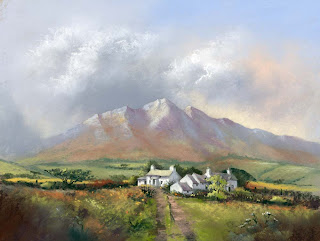
Treleddid Fawr

Treleddid Fawr, Pembrokeshire

If you travel down to St David’s and explore the countryside below Carn Llidi you will find this lovely old farm called Treleddyd Fawr. However you cannot see it the way I have painted it. I have used a lot of artistic licence with this one.

I like to paint buildings so that they are part of the landscape rather than dominating it and this view of the building is mostly obscured from this distance. To see the view like this I would have had to cut down a mass of overgrown hedgerows, several small trees and demolish a stone wall. I would also have had to hover about 100 feet up in the air to get the crag in this position.

I sketched the building from several angles from close quarters and the roof and chimneys from a 100 yards back (this being all I could see from that distance). I then drew a lot of thumbnail sketches to work out the positions, angles and perspective until I was happy with the composition.

Making the landscape suit your ideas is what makes painting so exciting, so don’t be reluctant to change things to how you would like them to be.

This painting is from my new book Painting with Pastels, signed copies are available from the website with a DVD of the same name is also available. Save £5 on the book/dvd offer

Painting reflections in still water

Ongoing at the moment is an exhibition of watercolours and pastels by Jenny Keal and myself at the Wyeside Arts Centre in Builth Wells, Powys. It covers a wide range of landscape subjects, plus a number of flower paintings, and at the moment the opening hours are mainly in the evenings when the venue is open for showing films, from 5.30 pm to 9 pm. For further information and to check opening times telephone 01982 552555

One of the watercolours on show at Wyeside is this one of Garreg-Ddu reservoir in the Elan Valley, viewed from high up on a hill. The painting illustrates well the impact of keeping reflections simple. This effect was carried out by liberally wetting the lake area with clean water, then washing in a light tone of blue-grey to suggest the general reflections of the hillsides. Then with a stronger mixture of the same colour, and hardly any water on the fine brush, the reflection shapes of the trees was painted into the still-wet surface, creating a lovely soft effect.

I then took a small flat brush and while the surface remained damp I pulled out the light reflection of the light crag, just to the immediate left of the dark reflection of the conifers. Full mirror-like reflections in still water lose their attraction because they become so detailed, so remember to keep them simple! You can see this painting in my book David Bellamy’s Mountains & Moorlands in Watercolour, and signed copies are available from our website

The panoramic sketch-book

When I go off on expedition I like to take a variety of papers – several sketchpads, plus a folder of various papers, some of which are tinted, and with a variety of surfaces. Occasionally I will use a specialist pad, especially when working near home, and an excellent sketchbook that has only recently come on the market is the Derwent Panoramic book. I’ve started using it for certain types of subject, and it has a lovely smooth surface of 165 gsm and can be used for watercolour sketching.

This simple watercolour sketch was carried out as a demonstration on a painting course. The panoramic format is particularly useful for extended mountain ranges and coastlines when a normal sketchbook often means you need to turn over a page halfway across a sketch and add the annotation ‘PTO’ (please turn over), which is hardly satisfactory. With this sketchbook it really makes you think about how you are going to arrange the composition before you start.

Another great bonus is that there is not really much room for over-working those nasty foregrounds that seem to give so many of us problems. It encourages us to play down the detail. If I know there is a chance of my needing a book of this format I stick it in the rucsack. Details can be obtained from the Derwent Pencil Company.

Nude figure drawing in glacial streams

Drawing from life is the best thing you can do to improve your drawing skills…..after all, if you can render a good likeness of the human figure where all the legs, arms and other paraphernalia should really all go in pretty specific places, then by comparison drawing a tree should be fairly problem-free. You only need to be vaguely accurate with the branches, for example, provided they are actually attached to the tree-trunk!

It is, however, rare that you get the opportunity to do some alfresco nude studies, especially at over 6,000 feet altitude as in this case where the model was bathing in water streaming off the Vignemale glacier! Whilst this has happened to me a few times, this is the only occasion that I’ve had the opportunity to carry out a nude study at such a high altitude.

The main lesson in this is not only that this sort of thing is excellent practice for you (drawing nude figures, I mean, not jumping naked into freezing lakes), but that it always pays to have your sketchbook with you and be prepared for all eventualities. You never know who or what is round the corner! You will find further advice on drawing the figure in my book David Bellamy’s Complete Guide to Watercolour Painting as seen on my website. One final piece of advice: wherever you are always ask permission before sketching or photographing anyone, especially when they are scantily clad or not clad at all.