David Bellamy – Creating a sense of sunlight in snow scenes

Injecting a little sunshine into your landscapes will give them a strong appeal, and the best way of achieving this is to lay cast shadows across a light surface. Nothing will give a more striking or fresh approach than doing this across a pristine snow scene. With winter upon us you will hopefully have opportunities for practising this effect before long.
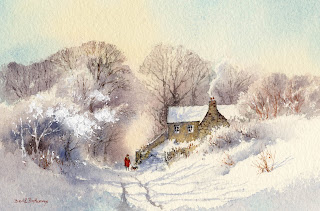
In this watercolour the sense of strong sunshine has been achieved by laying cast shadows across the foreground and over the left-hand part of the roof. For the shadows I used a mixture of cobalt blue and cadmium red, although very little of the latter was included as it is a powerful colour. This produces a lovely, fresh shadow and is not as dull or overpowering as say burnt umber mixed with the cobalt blue. French ultramarine is also a superb colour if you wish to substitute it for the cobalt blue.

Note also the warm colours employed on the house and trees – this takes away the utter coldness of a snowy landscape. Aim to have white highlights on the snow, but not an overall whiteness. On the left-hand trees I deliberately applied white gouache with a painting knife. I don’t normally do this, but I wanted to show a variety of techniques in my Winter Landscapes in Watercolour book, where this scene appears.

This painting is now on show with several others in the Ardent Gallery, in the High Street, Brecon tel. 01874 623333, and is also available as a Christmas Card, available here 

Don’t forget to watch out for that snow – it rarely seems to stay long these days so make the most of it whilst it’s still around, and preferably before all those tobogganers have churned it all up!

David Bellamy – Watercolours in The Arctic

The sun has just risen and Torben is already up, proclaiming loudly on the beauty of the intense colours in the sky. I fight my way out of the sleeping bag, automatically grasping my painting gear while gasping at the temperature – even with the stove firing away the hut is cold. The window is in the perfect position to view the sun casting warm fingers across the icy wastes, and turning ice hummocks to gold.
A few pencil strokes shiver their way across the sketchbook and then I apply the watercolour washes, starting with the blaze of light that is burning away at the edge of the vertical crag. This is chiefly quinacridone gold, blending into some less violent Naples yellow, then pushing outwards, away from the point of maximum brightness with a mixture of cobalt blue and cadmium red. In the hunters’ hut this is luxury sketching for a change, especially when Jens puts a mug of steaming tea into my hand.

Later on I sketch Isak tending to his sledge-dogs in his usual kindly manner, and so in the finished painting here you can see how I have brought the two separate sketches together to form a narrative. The secret of making sunlight ‘burn’ into a feature is to keep the critical edges soft and push the light area into the feature as though it has burnt a hole in the side. In the foreground I have covered the wet blue washes with cling-film and moved it about until I am satisfied, then left it to dry. It is a remarkably effective way of suggesting ice and sastrugi ridges. Beneath the sunburst I included some of the warm gold to suggest the reflections of the colour in the ice. The painting was carried out on Saunders Waterford 300lb not paper.

This is one of a great many paintings in my new book, David Bellamy’s Arctic Light, which has just been published by Search Press. It is crammed with paintings, sketches and anecdotes, and contains one chapter describing some of the methods used to sketch and paint, often in almost impossible conditions.  Subjects vary from glaciers, sea ice, mountains, wild seas, waterfalls, people and many wildlife works are included, from polar bears, walrus, musk ox, Arctic foxes to birds. More details can be seen on my website.

David Bellamy – Choose your moment

Most of you are probably aware that I rather enjoy being out in nature with my sketchbook and a Danish pastry (that’s a cake, of course, not a Scandinavian model). I always try to plan my excursions to coincide with the optimum conditions for my objectives, so last weekend I decided to go over to the Mid-Wales Fjordenland to sketch the snow-covered hills and filled-up reservoirs. This is an area more commonly known as the Elan Valley, a sort of Welsh lake district. With all the rain we have experienced in December and early January I hope to see scenes I have not witnessed for many years: the reservoirs so full that those hideous margins between the landscape and water are covered over.

Sure enough, the reservoirs looked stunning, even without the help of the sun, with Garreg-ddu reservoir (on the right) looking especially magnificent. So, it pays to choose your moment, in this case after heavy rains when the water is high in rivers, lakes and reservoirs and waterfalls are really at their best. Leave it for the hot days of summer and you are quite likely to encounter just a trickle of a waterfall! I didn’t get an opportunity to sketch this scene as the light was fading and I was parked in an awkward spot, so I might return soon on a better day and render it in watercolour.

I did, however, spend some time sketching other subjects, one of which was done in watercolour. As I began the sketch it started to rain, and kept raining until I put it away and then it stopped. That is pretty much par for the course!

Much of the intensity of the colours has washed off, but the black watercolour pencil has kept the image intact. I did this from a rough patch of ground mainly covered in dead bracken. There was no path and the charm of these places from the artists’ point of view is that the awkward approach inhibits most other people from coming over to see what you are up to. An advantage of days like this is that if you wear a large hood it isolates you from the voyeurs and can impart a sort of mysterious non-gender type of person to others – a great advantage!

David Bellamy – Making the most of poor weather

I hope all of you out there had a great festive season, or if Christmas isn’t your thing then you have been enjoying yourself. I seem to have been everywhere except by the laptop, hence the long silence. One place I did visit just before Christmas was sunny Devon, but as I found it gloomy and misty I decided to make the most of the atmosphere and capture some wet-into-wet mistiness. Whatever the weather is doing out there it always has something for the landscape painter.

This watercolour sketch was carried out on a cartridge sketch-pad. I chose this because firstly the smooth paper dries quicker than a rougher surface, which in the damp atmosphere would take some time to dry; and secondly I wanted to juxtapose the softness of the wet-in-wet technique with the hard sharpness that is accentuated on smooth paper. If you don’t like cartridge paper for quick washes try a hot pressed paper – Bockingford comes in ideal HP pads for this sort of work. First of all I laid on Naples yellow in the sky, then drifted it to the left where I blended in a light green wash where the two largest trees appear.

Without pausing I painted the fainter tree in with ultramarine and burnt umber using a strong mixture to keep the shape of the tree – working into the damp paper you really don’t want much water on the brush!  Again without pausing I then drew into the green wash with an indigo watercolour pencil while the wash was still damp. I sat back and drank a coffee while the sketch dried and then I laid a medium tone around the trunks of the tall trees, thus highlighting them. Note also how I have left the vegetation under the trees sharp-edged to counter the soft, misty background – much easier to achieve on a smooth surface. It’s only a rough sketch but it gave me great enjoyment and brightened up an otherwise gloomy day.

If you need cheering up then why not tune in to CBEEBIES on BBC Television on Saturday 9th January at 10.45am and 15.40 – Catherine, my daughter is doing some of her whacky stunts. She is out in Australia at the moment and next month will be performing in Adelaide.

A very Happy New Year to you all and may it be your best painting year yet!

David Bellamy – Gearing up for winter sketching

It’s a pretty miserable, wet, misty day here in Mid-Wales, the sort that puts many people right off going out to sketch the landscape, but even in winter we can get some fine days when being out with a sketchbook is a real treat. Recently we had a fall of snow and the Black Mountains looked glorious in the late November sunshine as you can see below.

Now that winter has arrived it’s worth gearing up ready for that day when you wake up and the scenery outside is stunning, and begging to be painted. Preparation in advance is the key: if you have to search for everything the snow may well have melted, the early morning atmosphere dissipated and the best part of the day gone before you are ready for action.
For sketching if you want to work quickly with minimum fuss a few pencils, watercolour pencils or sticks and a small cartridge sketchbook are all you need, plus your camera. Thin gloves of the Thinsulate sort help you draw in cold conditions, but a flask with a hot drink or soup can be a great morale-booster. Even better while you are sketching is a thermal travel mug which keeps your drink hot for hours – very welcome as you wait for a wash to dry or contemplate how much more of the composition to include. Note how the flask is prominent on the sledge during this sketching break amidst Arctic icebergs! The trouble with ice and snow is that watercolour is the best medium to capture their subtleties, but in temperatures below zero this is not the easiest option……….

You can get further tips and techniques in my book Winter Landscapes in Watercolour which is available from all good bookshops, or if you would like a signed copy, from my website. At the moment there is a special free offer of a pack of Christmas cards with each copy of the book. Whatever you do don’t miss out on the marvellous opportunities for capturing winter landscapes when the colours, the light and the trees are all so evocative. Just make sure you choose the right day to venture out!