Painting holiday in Canada

I’ve just returned from East Anglia, where I indulged in my passion for maritime scenes and collected a number of sketches of old sailing barges under way in Harwich Harbour. Despite the distractions of a giant ferry crashing into the quay and the subsequent charging around of lifeboats, harbour patrol launches, tugs and kitchen sinks, I managed to achieve some lively images which will be the subject of a future blog.
Canadian rockies

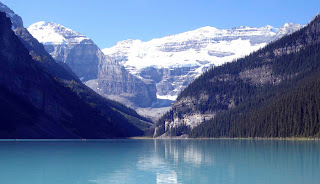
Canadian Rockies

We still have vacancies on our painting holiday to Canada on September 1st when Jenny and I take a group to the Rockies to paint some amazing scenery. I shall be demonstrating how to paint the sublime natural scenery.  It is easy to be overawed by such spectacular scenery, so I will be showing how to cope with the big landscape and produce an exciting composition, as well as many other aspects of painting, whether you like to work in watercolour, oils, pastels or whatever. There will be plenty of time to paint and sketch, and if anyone wants to do a little walking that would be great, but it is optional.

The holiday runs from 1st to 14th September, and is organised by Spencer Scott Travel in conjunction with The Artist and Leisure Painter magazines. For further information please email  info@spencerscott.co.uk or telephone +44 (0)1825 714310 or check the website www.spencerscotttravel.com

Finding time to blog and sketch

Trying to maintain a regular blog is pretty much impossible for me, especially at the moment with so much happening. There simply isn’t enough time to do all I want. Since the previous post Jenny and I have joined in a major protest in Mid Wales at the start of a public inquiry into five wind farms which, if given the go-ahead will industrialise vast swathes of beautiful landscape and trash the main economy based on tourism. Following that I demonstrated in a slightly different style at Patchings Art Festival in the St Cuthberts Mill and Search Press marquees, and without a break continued to Derbyshire to run a painting course at Derbyshire Arts.

Hardly back from Derbyshire and I had a rather significant birthday party, which unfortunately was interrupted by the local health and safety officials as pictured above. Nevertheless, much fun was had by all concerned, and nobody got too wet. This interlude was then followed by a spot of filming for another project, until at last! – yesterday I could disappear off into the hills and relax for the first time in a few weeks.

There’s been some marvellous weather for working out of doors lately, and long may it continue. I have a number of sketching kits, ranging from large expedition ones to pocket-sized pads with a pencil or two plus an aquash brush – it really is worth taking a few materials with you, plus a camera, to catch a fascinating composition while you are out. If you feel embarrassed sketching out of doors then hide your sketchbook in a copy of the Beano or other comic and pretend to be doing the crossword……enjoy the summer.

Creating a strikingly moody landscape in watercolour

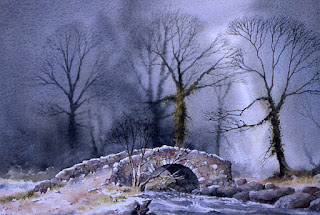
The combination of a striking centre of interest with a soft, misty background can be a powerful recipe for a stunning composition. To achieve this is it hard to beat the combination of masking fluid and the wet-into-wet watercolour technique. In producing a strong contrast between the soft, ethereal misty background and the hard-edged focal point you will be creating a really head-turning image.

Hisley bridgeThis watercolour of Hisley Bridge on the edge of Dartmoor illustrates the effectiveness of painting masking fluid over the bridge before doing any painting, then applying very fluid washes wet-into-wet for the background, bringing the wash down over the bridge with impunity, as you can lift off the masking fluid once it has dried and hey presto! the bridge appears again. The sense of mood has been accentuated by limiting the background colours in the wet-into-wet wash, with warmer colours being applied in the bridge and foreground.
  If you are interested in this particular scene there is a stage-by-stage demonstration of the painting in my book Painting Wild Landscapes in Watercolour, published by HarperCollins, and for more information see my website.
On Friday 7th June I shall be demonstrating at Patchings Art & Craft Festival, in the St Cuthberts Mill marquee at 11am, and the Search Press marquee at 3pm, then again on Saturday morning at 11 am in the St Cuthberts Mill marquee. On each occasion I’ll be using the marvellous Saunders Waterford High White paper manufactured by St Cuthberts Mill, with whom I’ve worked for a great many years now. You can take it from me that when you are demonstrating you have to have total faith in the paper, and Waterford has never let me down.
Sadly Jenny won’t be at Patchings this time as she has not been well. It’s a great disappointment  as she loves demonstrating at the festival, but hopefully she’ll be back in action at next year’s event.

The Pure Watercolour Society Exhibition

This weekend I had a very pleasant sojourn in the Cotswolds, invited to join in the exhibition of the Pure Watercolour Society at the Windrush Gallery situated in the delightful village of Windrush, just west of Burford. This was formerly the studio and home of James Fletcher-Watson who was passionate about traditional watercolour painting, and became the first President of the PWS in 1999. This exhibition marks James’ centenary and includes a great many of his original paintings.

PWS Painting session sm

Pure Watercolour Society

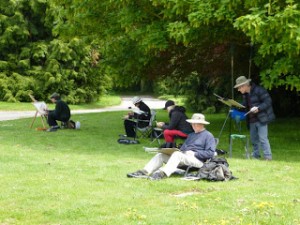
The picture shows members of the PWS hard at work in a Cotswold farmyard. We were sketching the lovely old buildings, but what caught my eye was the wonderful collection of decaying rubbish hidden behind a barn: don’t ignore those rusting old drums and bits of machinery half-hidden in the weeds. There was even an old anvil lying in the midst of it all. These little features can add so much to a painting.

As well as James’ paintings the artists represented include David Curtis, Trevor Chamberlain, David Howell, Winston Oh, Tony Taylor, Peter Cronin, Andrew Hucklesby, John Yardley, Philip L Hobbs and Ian Piper. The exhibition continues until 28th May and is open 11 am to 5 pm daily. Tel: 01451 844425 The exhibition launches a new book commemorating James’ work, and in which several of us were privileged to include an example of our work. Try to get along and see the exhibition if you can, as it contains a wonderful variety of styles by a number of watercolour masters.

A bump in the road

Every now and again our plans are thrown off course and we have to adapt to the new circumstances. In April I suffered one such ‘bump in the road’,  a slipped disc and I ended up in hospital. At the same time I was given the news that I need a major operation for an unrelated issue this summer so I have had to cancel all my demonstrations and events for the foreseeable future. I am sorry if any of these cancellations have affected you. I may not be accompanying David at his events either and will miss seeing old and new friends. but I hope to be back on course again by the autumn.

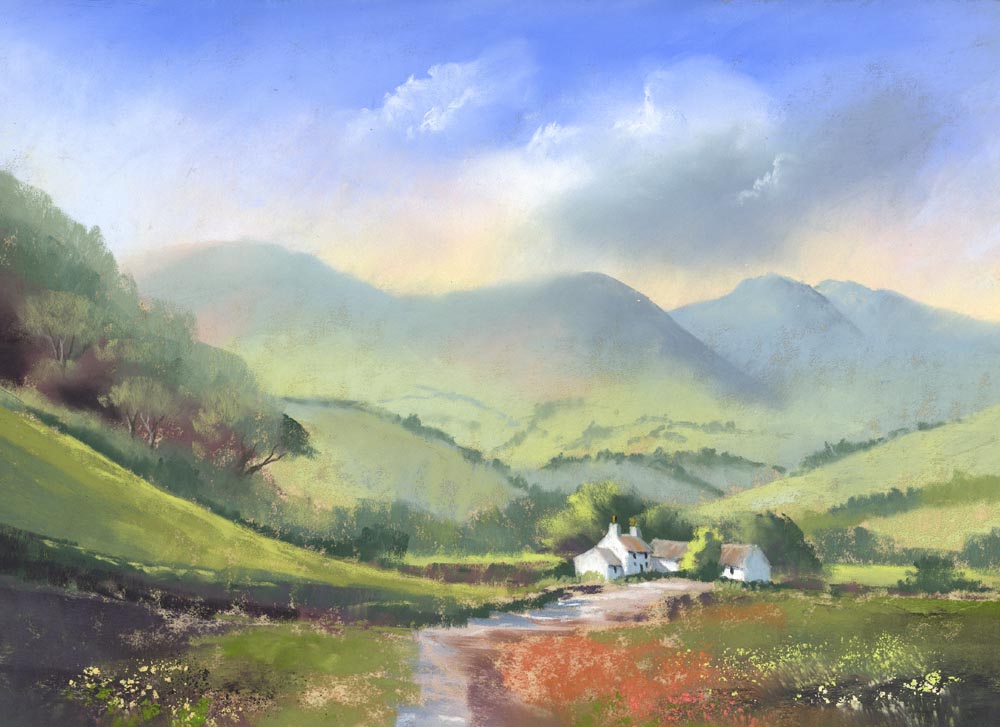
The pastel painting below was the last demonstration I did this year, for Llantarnam Grange Art Group in Cwmbran in March. The theme was ‘creating atmosphere’ and pastel is the ideal medium for this purpose. Softening the edges of the distant features in order to create a sense of atmosphere is relatively simple with pastel. To create this effect of clouds over the hilltops, just gently stroke some of the sky colour down over the distant hills. This pushes them into the distance.

Crickadarn

Crickadarn, Mid Wales, Pastel by Jenny Keal

The same method was used lower down in the distant hills, softening the green colour of the lower slopes into the blue/grey. This softness is emphasized by making the edges of the focal point sharper and the tones darker. All these techniques help to create the illusion of recession in a painting.

You can see this technique and many others, demonstrated in live action on my DVD, Painting with Pastels, available in our online shop.

I hope you find time to get out in the countryside this summer to paint and sketch and store up subjects for the coming winter months. Nature has a way of invigorating and at the same time restoring tranquility in our busy lives.