DAVID BELLAMY: HAPPY CHRISTMAS

It feels very un-Christmassy here in rain-drenched Pembrokeshire at the moment while I’m recovering from a fairly mild dose of ‘flu, and I’ll need to be in top form next week when my two over-active grand-daughters arrive. Jenny will be safely ensconced in Hampshire with her ‘little’ ones while I face the full force of furious chaos.

A fall of snow would help of course, with the distraction of building a snowman while I sneak in a quick watercolour sketch if I’m lucky. Plotting it is fairly easy as I can take the girls up handy toboggan slopes at the same time and where the mountains are in full view. The attached watercolour of the Black Mountains gives an idea of what can be done reasonably quickly. In cases like this where speed is vital then watercolour pencils are truly effective.
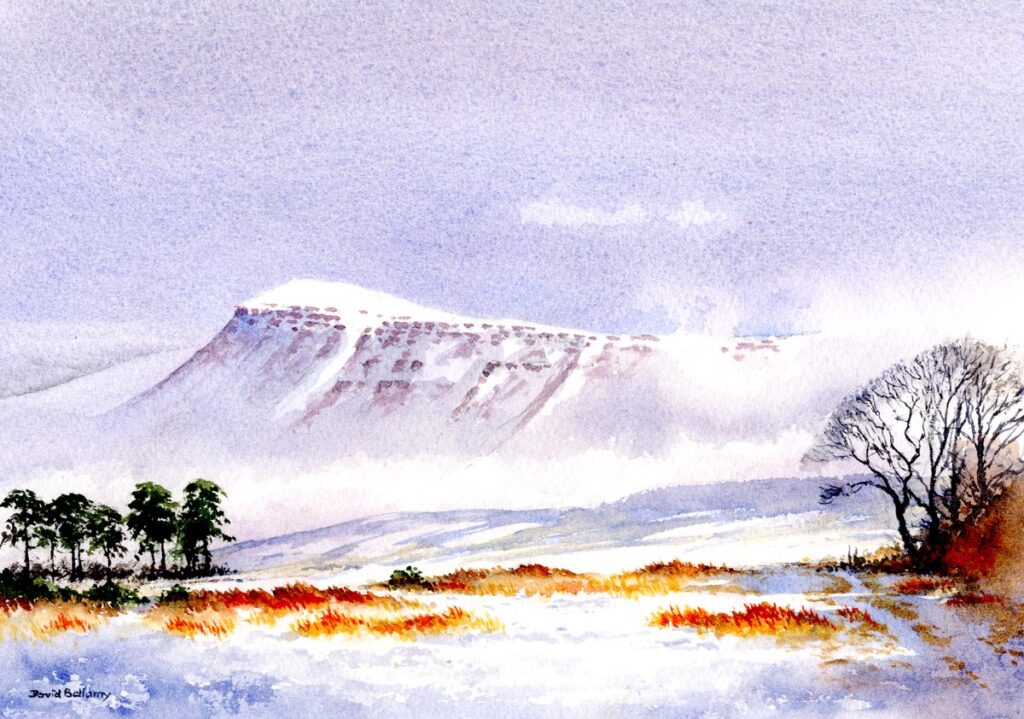
Note how the track on the right-hand side has been defined in the snow with intermittent stabs of the brush to suggest a winding effect. For this I used transparent red oxide, and also floated it into the dark mass under the trees while this was still wet. The background at this point has been kept simple with just a stroke or two of a wash brush, and the mountain ridge at the top has been lost in cloud in places. These are all really simple techniques which use the watercolour medium to advantage. This has been painted in the studio on Saunders Waterford 140lb NOT paper, but in a sketch these effects can be achieved in two or three minutes with watercolour pencils, working freely without any need to create a complete landscape composition.

Enjoy your Christmas and have a great time. I wish you every happiness for Christmas and 2026 and evry success with your painting.
David Bellamy : The Value of White Gouache

Featured

DAVID BELLAMY: THE VALUE OF WHITE GOUACHE

This is the time of year when many get out their sketching gear ready to go on holiday and enjoy some artwork in a new place. I always take my box of watercolour pans along with me, mainly for watercolour sketches, though sometimes I work on a full painting out of doors. For certain subjects it’s actually quicker working in watercolour than trying to render the subject in pencil or pen.

In addition to the half-pan colours I carry a few tubes of watercolours, and these are usually colours that I don’t have in my box but I expect to be useful for a particular trip. A secondary reason is that if I happen to lose my box of paints at least I have the tube colours to fall back on. One tube I always take is that of white gouache, as it is so useful. As well as being essential for tinted papers it is great for little highlights or perhaps rectifying part of the work that has gone astray.

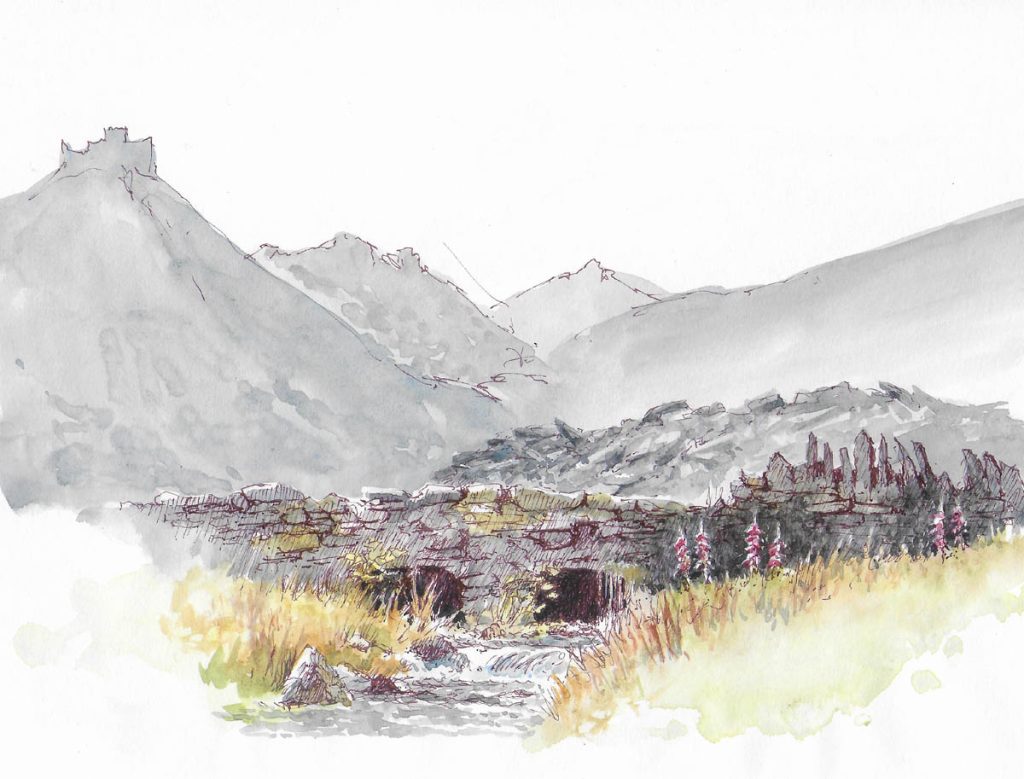
I sketched this stone bridge last week in Cwmorthin, a slate-quarrying area near Blaenau Ffestiniog, and you can see the piles of slate heaped up behind the bridge, as well as mountainous slate slag-heaps in the distance. Those I only indicated vaguely, as the bridge was my main objective. I drew this with a sepia pen and wanted to highlight the foxgloves as they broke up the stonework and added colour to the scene. Alas, I messed this up a bit. One of the difficulties we have as landscape artists is that we don’t have the great range of tones that occur in nature, so we have to modify our tones a little. My foxgloves weren’t too bad, but I felt they could stand out better, so I applied white gouache over them and then when that was dry overlaid alizarin crimson over the gouache. This certainly made them stand out more, and although they are far from perfect I do have a reasonable sketch from which to work up a painting. So it’s always helpful to have a tube of white gouache with you on your travels.

On Saturday I shall be book-signing at Erwood Station Gallery & Craft Centre, about 8 miles south of Builth Wells just off the A470, from 2 to 4 pm. I will also be showing quite a number of the painting from the new book, Watercolour and Beyond, with captions on certain techniques and effects in the painting, and I’ll be happy to answer any queries you may have about painting landscapes, so do come along if you can make it. It’s a lovely spot overlooking the River Wye. Their phone number is 01982 560555. The paintings will be on display throughout July, so if you can’t make it on Saturday they will be around for a while. And incidentally, the book covers quite a bit about working with gouache paints. Enjoy your summer travels and keep safe!

David Bellamy: The value of drawing

Many of us are so eager to start painting that we tend to gloss over the need to get the drawing right before our brush touches the paper, and then we wonder why the composition doesn’t work too well. I love drawing, and drawing and doodling are a wonderful therapeutic activity, ideal for calming one after the stresses of modern living. I take my sketching in the field very seriously, even when I may have no need for any more sketches to add to the thousands already done.

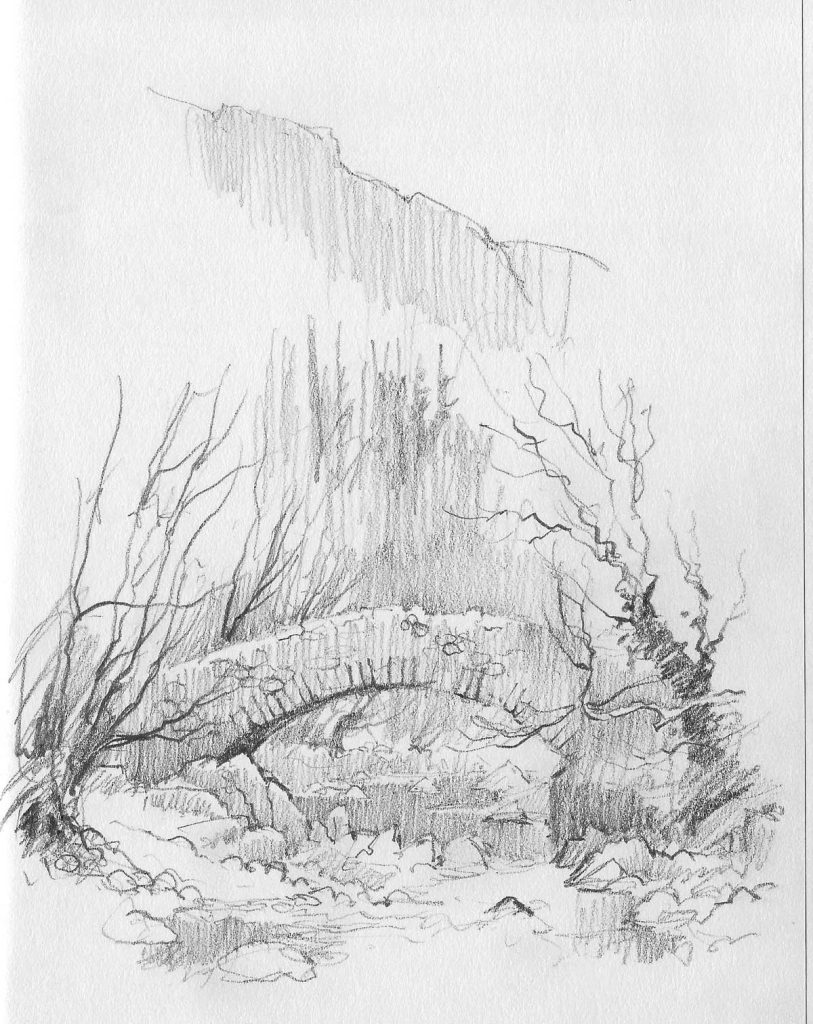
This is a sketch of the attractive old Doctor’s Bridge in Eskdale. Although not completely finished, it illustrates several vital points for landscape artists:

  • By carrying out a sketch you are already arranging the composition for a subsequent painting and working out everything you need for the finished result;
  • Sketching is the ideal time to assess the major tonal values in a scene- how dark? how light? do any features benefit from an adjustment of tones?
  • More than anything else you are learning to observe, learning how to draw and seeing how different aspects of the scene relate to each other;
  • Note the cursory manner in which the background has been rendered. If you need to work quickly this kind of treatment is useful for the less important parts of a composition.

Getting the drawing right is especially vital with watercolour painting, so do try to practice this as often as you can. It will have a great impact on your painting.

This summer has been especially hectic, culminating disastrously when I experienced a heart attack at the beginning of September. Luckily in just over an hour after ringing for an ambulance I was on the operating table witnessing the whole operation as they cleared the blockage in an artery. The NHS staff were brilliant and deserve the highest praise. Please be aware that if you get chest pain that runs down into your arms and perhaps up to your jaw you need to get help quickly – don’t delay! And don’t forget, the power of art is quite amazing. Sketching is a wonderful way to de-stress and relax you. I can’t recommend it highly enough.

David Bellamy – Painting limestone scenery in watercolour

I’ve managed a pretty wild and wonderful autumn this year, though it has left me breathlessly out of kilter on the blog-writing front, I’m afraid. How I wish there was more time for writing, which I love, but sadly in this robotic world there are so many threats to writers and their writing-time. For eample, in New Zealand their libraries archive has intended to put thousands of books’ contents onto the internet, but it seems that after world-wide protests they’ve just realised there’s a thing called copyright involved!

 We’ve been blessed with a gorgeous little grand-daughter by the name of Beatrix, and look forward to meeting her on the run-up to Christmas. Her Dad’s going to be performing in pantomime at Margate, so it’s going to be a bit riotous, Covid-permitting, of course.

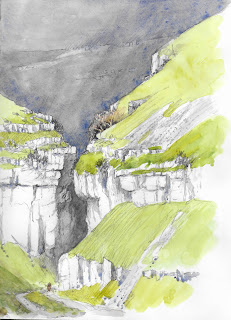
 This is a watercolour sketch of Gordale Scar in Yorkshire, carried out on a beautiful calm, sunny afternoon in October while sitting in a most uncomfortable position on extremely steep ground high above the valley. The light falling on the limestone really made the rock stand out, particularly against the shadowy parts. It is deliberately overworked so that I have all the details to produce a large studio watercolour, and my awkward position didn’t help. This is actually only the right-hand half of the composition and the cartridge paper has been left unpainted where the sunlight is hitting the limestone. 
   
There is too much green for my liking, but grass growing on limestone has that intense colour, and I wanted to record a faithful rendering. In a studio painting I will doubtless take more liberties, lose a lot of hard edges and make other adjustments, but my point here really is to show how working out of doors like this is to me not just a means of acquiring the information for a finished painting, but also of observing how the traditional approach will appear, so that I can see where I need to be more creative in the later attempt.

The Covid-induced layoff has been a real nuisance, but we are now organising courses for 2022 as you will find on my website .  There is one in Mid-Wales in April, and another in Cornwall in September, both popular locations with lots of interesting subjects. I may well be adding more in due course. Also on the website you will find information on my books, the last one published being the Landscapes Through the Seasons in Watercolour, and they are all available via the website

I hope you are managing to get out and about with your sketching and painting gear – even in December we can get some lovely days, and the low light can create some fabulous cast shadows.

David Bellamy – Painting a Downland scene in winter

I hope during this lengthy lockdown you are able to get out for exercise, fresh air and perhaps a little sketching, as these things are so vital to our well-being. Although it’s quite cold today, these winters are pretty mild compared to what it was like when I was a youngster, so there are many occasions when it is fairly comfortable to work outside. I live at the foot of vast moorlands, so I get up there as often as I can. In mid-January I sat on a rock painting distant snow-covered mountains in warm sunshine, in more comfort than many a summer day.

    Today I have a winter scene on the Sussex Downs, which I did many years ago. A light coating of snow gives you the opportunity to bring in some colour while retaining the white of the paper where you wish to indicate pure snow. Keeping the landscape light in this way gives you the opportunity to make the most of cast shadows which will stand out strongly. I have cut a little off the left-hand side so that the details are not too small, although this does make it look as though I’ve plonked the farmhouse in the centre. Note the intermittent lines of ploughed furrows, which keeps it from being an overwhelming foreground. The massed trees in the distance have been enhanced by touches of highlights in places and the closest edge stands out where I have described one or two individual trees. The painting was done on Saunders Waterford NOT 140lb paper. 

    I shall be doing a couple of online watercolour workshops with Shopkeeparty in February, the first being on Thursday 11th at 2pm. This lasts for 45 minutes, is free, and you can join me in painting a simple landscape. All the details, including art materials are shown on the Shopkeeparty site and the free link is    https://us02web.zoom.us/webinar/register/7916124614355/WN_kKSNDBCgQ9CyycEOLCCRgQ

The second workshop is on Thursday 25th February at 3..30pm and lasts 2 to 3 hours, for which there is a fee. Again, all the details are on the Shopkeeparty site. I hope to see you there. In the meantime, enjoy your painting.