DAVID BELLAMY: HAPPY CHRISTMAS

It feels very un-Christmassy here in rain-drenched Pembrokeshire at the moment while I’m recovering from a fairly mild dose of ‘flu, and I’ll need to be in top form next week when my two over-active grand-daughters arrive. Jenny will be safely ensconced in Hampshire with her ‘little’ ones while I face the full force of furious chaos.

A fall of snow would help of course, with the distraction of building a snowman while I sneak in a quick watercolour sketch if I’m lucky. Plotting it is fairly easy as I can take the girls up handy toboggan slopes at the same time and where the mountains are in full view. The attached watercolour of the Black Mountains gives an idea of what can be done reasonably quickly. In cases like this where speed is vital then watercolour pencils are truly effective.
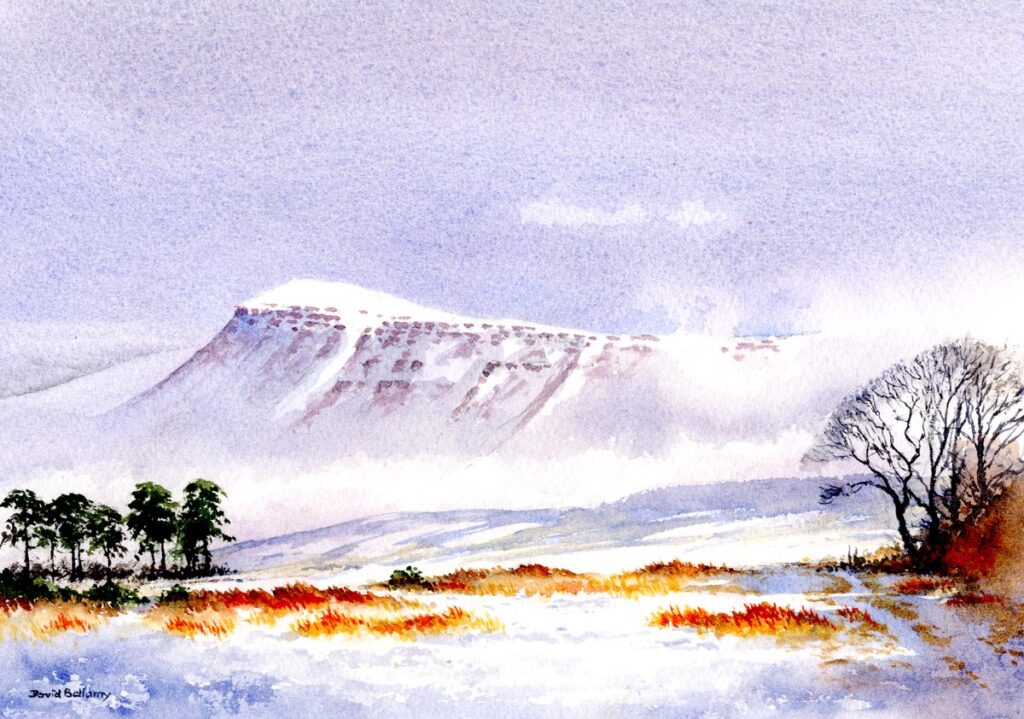
Note how the track on the right-hand side has been defined in the snow with intermittent stabs of the brush to suggest a winding effect. For this I used transparent red oxide, and also floated it into the dark mass under the trees while this was still wet. The background at this point has been kept simple with just a stroke or two of a wash brush, and the mountain ridge at the top has been lost in cloud in places. These are all really simple techniques which use the watercolour medium to advantage. This has been painted in the studio on Saunders Waterford 140lb NOT paper, but in a sketch these effects can be achieved in two or three minutes with watercolour pencils, working freely without any need to create a complete landscape composition.

Enjoy your Christmas and have a great time. I wish you every happiness for Christmas and 2026 and evry success with your painting.
SNOW SCENES IN THE MANNER OF THE IMPRESSIONISTS

DAVID BELLAMY: SNOW SCENES IN THE MANNER OF THE IMPRESSIONISTS

It’s been an all-action autumn with sketching adventures in the Peak District, Lake District, wildest Sussex and last week a fabulous winter day high up on the Brecon Beacons in icy conditions, so there’s been little time for blogging. I’ll try to fit in a blog post on the Lake District fun and games when I can, and also the episode in Sussex where I hadn’t realised such wild landscapes existed.

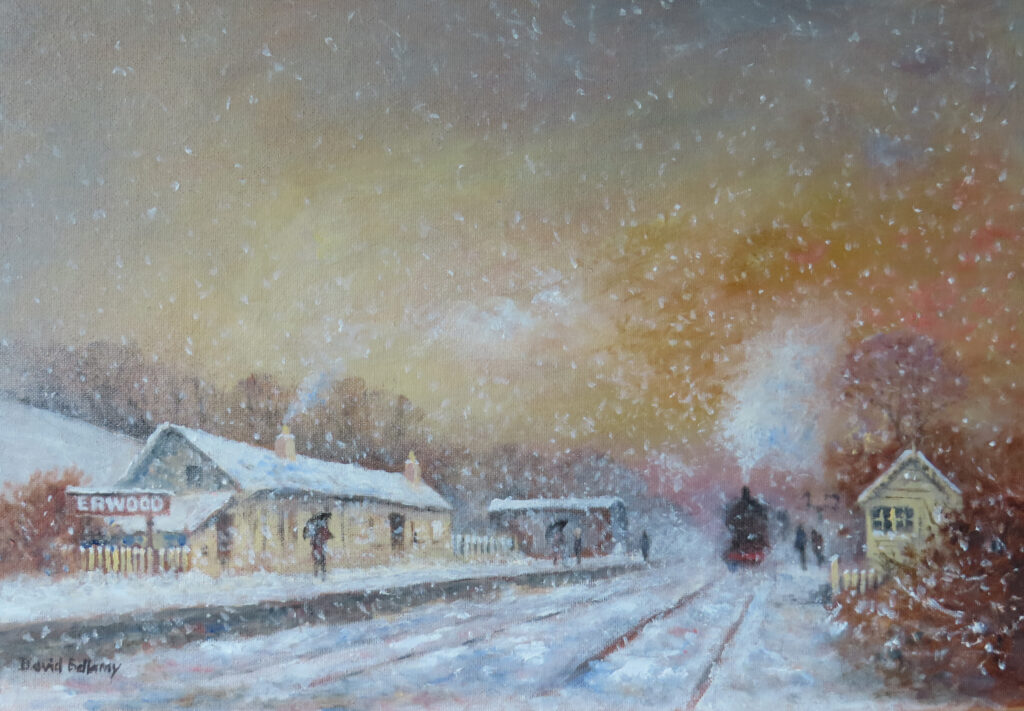
The January issue of Leisure Painter (which is on sale now) features my article on painting snow scenery using methods practiced by the French Impressionists, and for this I have reverted to painting in oils. Monet, Sisley and Pissarro were the main ones who worked on snowbound landscapes, and as Monet enjoyed painting trains I painted a reconstruction of a scene at Erwood Station in the 1960s.

This shows the 4.10 train from Brecon approaching Erwood Station in falling snow, the atmosphere of steam, snow and smoke making many of the images delightfully blurred as in a Monet painting. I declined to make the railway lines more distinct and detailed as Monet would render these with a few swipes of the brush. Where the snow lay deep on the ground I introduced not just blues and greys, but pinks, ochres and even orange, each of which suggested a vibrancy and spontaneity in a manner loved by the Impressionists. Larger blobs of flake white – a white favoured by Monet as it dried rapidly – I applied with a painting knife, then brushed part of the edges of the heavy impasto to blend in the lower parts.

You can see a more detailed description, with further examples of the techniques of Pissarro and Sisley in the current Leisure Painter magazine. I’m really enjoying going back to oil painting at the moment. These ‘Impressionist’ paintings, along with many watercolours, are on display at Erwood Station at the moment. The centre is well signposted off the A470 just north of Erwood Village in Powys, a great place for tea and cakes and a warm welcome. Telephone 01982 560555 open Tuesday to Sunday in winter.

My Watercolour and Beyond book shows a few examples of rendering snow and ice using methods such as glazing, watercolour ground, tissue paper, brushing white gouache over darker washes to create textured snow-cover, and cling film for patches of ice. Many of these techniques are quite different from my normal way of working and are not just effective, but great fun to try! Experimenting and bringing a sense of exciting anticipation into your paintings can be quite inspirational – go for it!

DAVID BELLAMY: ADDING VARIETY INTO A LANDSCAPE

Often, even in a stunning landscape subject, I feel the need to add something of myself into the composition to enhance it as a painting. Whilst this may involve introducing an extra tree, perhaps a more handsome specimen than is present, or enlarging a feature to give it more presence, or many other such alterations, here I will concentrate on adding a little variety to the existing features in a scene to breathe fresh life into it.

In this scene set in Mid-Wales the only feature I have added is the puddle below the right-hand gate which helps as a lead-in to the farmhouse. The main point I would like to put across, however, is the addition of colours into the outbuilding roof, and its exaggerated wonkiness at the top and bottom. I used cadmium red and cobalt blue on the corrugated iron roof, leaving some white untouched paper for highlights and a mixture of the two colours on the darker left-hand end. Energetic dry-brush strokes of the brush work well in this situation, and any slight mess at the bottom can be overpainted with a dark mixture of burnt umber and French ultramarine as in this structure.

Sometimes a chimney can benefit from being a different tonal value than the gable end of a building, and as you see here I have made it dark, then losing the dark tone as it merges into the wall below. It is better to let this gradually change in this way, rather than paint a strong and hard definition between chimney and main structure as you see in many buildings. These are just minor points but they can have a striking effect on your finished work.

I have been invited to demonstrate at the International Watercolour Masters exhibition in Lilleshall Hall in Shropshire on 13th May 2026. You can find details at: https://internationalwatercolourmasters.com/portfolio_page/david-bellamy-uk/?v=7885444af42e

I am looking forward to the event and hope to see you there. I’ll be happy to answer questions, and do bring along any of my books you would like signed – this is something many people bring up when they come along and have left the book behind! Enjoy your painting during the rest of this amazing summer…..or maybe you are longing for a bit of good old British autumn drizzle for a change?

David Bellamy : The Value of White Gouache

Featured

DAVID BELLAMY: THE VALUE OF WHITE GOUACHE

This is the time of year when many get out their sketching gear ready to go on holiday and enjoy some artwork in a new place. I always take my box of watercolour pans along with me, mainly for watercolour sketches, though sometimes I work on a full painting out of doors. For certain subjects it’s actually quicker working in watercolour than trying to render the subject in pencil or pen.

In addition to the half-pan colours I carry a few tubes of watercolours, and these are usually colours that I don’t have in my box but I expect to be useful for a particular trip. A secondary reason is that if I happen to lose my box of paints at least I have the tube colours to fall back on. One tube I always take is that of white gouache, as it is so useful. As well as being essential for tinted papers it is great for little highlights or perhaps rectifying part of the work that has gone astray.

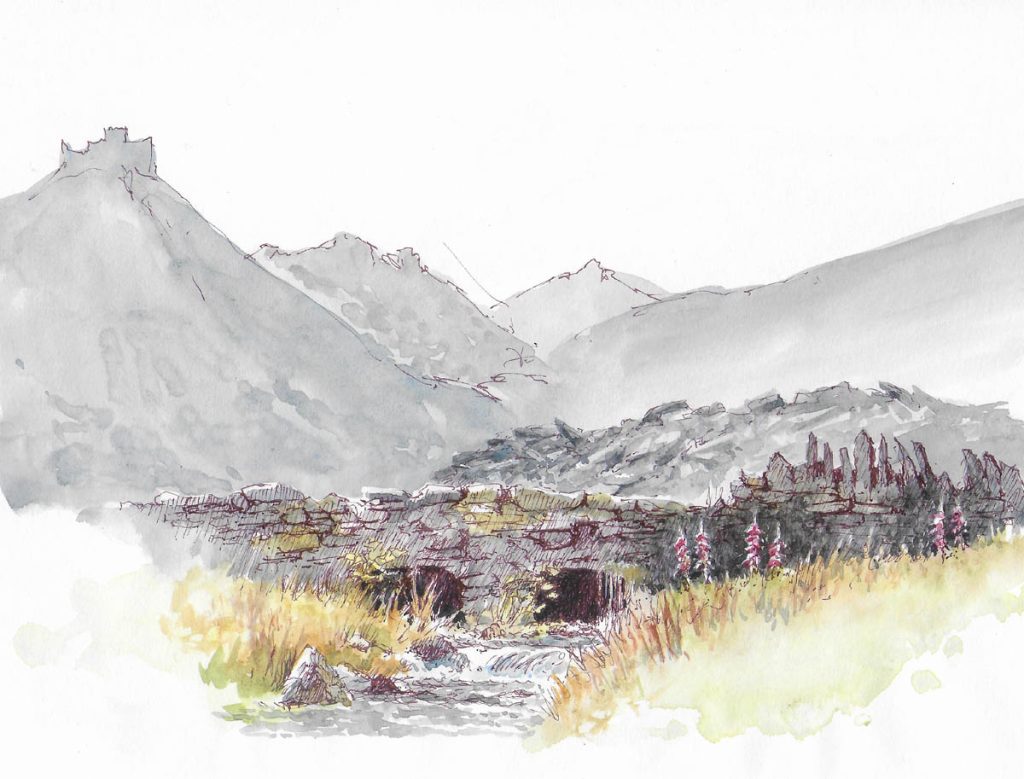
I sketched this stone bridge last week in Cwmorthin, a slate-quarrying area near Blaenau Ffestiniog, and you can see the piles of slate heaped up behind the bridge, as well as mountainous slate slag-heaps in the distance. Those I only indicated vaguely, as the bridge was my main objective. I drew this with a sepia pen and wanted to highlight the foxgloves as they broke up the stonework and added colour to the scene. Alas, I messed this up a bit. One of the difficulties we have as landscape artists is that we don’t have the great range of tones that occur in nature, so we have to modify our tones a little. My foxgloves weren’t too bad, but I felt they could stand out better, so I applied white gouache over them and then when that was dry overlaid alizarin crimson over the gouache. This certainly made them stand out more, and although they are far from perfect I do have a reasonable sketch from which to work up a painting. So it’s always helpful to have a tube of white gouache with you on your travels.

On Saturday I shall be book-signing at Erwood Station Gallery & Craft Centre, about 8 miles south of Builth Wells just off the A470, from 2 to 4 pm. I will also be showing quite a number of the painting from the new book, Watercolour and Beyond, with captions on certain techniques and effects in the painting, and I’ll be happy to answer any queries you may have about painting landscapes, so do come along if you can make it. It’s a lovely spot overlooking the River Wye. Their phone number is 01982 560555. The paintings will be on display throughout July, so if you can’t make it on Saturday they will be around for a while. And incidentally, the book covers quite a bit about working with gouache paints. Enjoy your summer travels and keep safe!

DAVID BELLAMY: CREATIVE GRANULATING IN A WATERCOLOUR LANDSCAPE

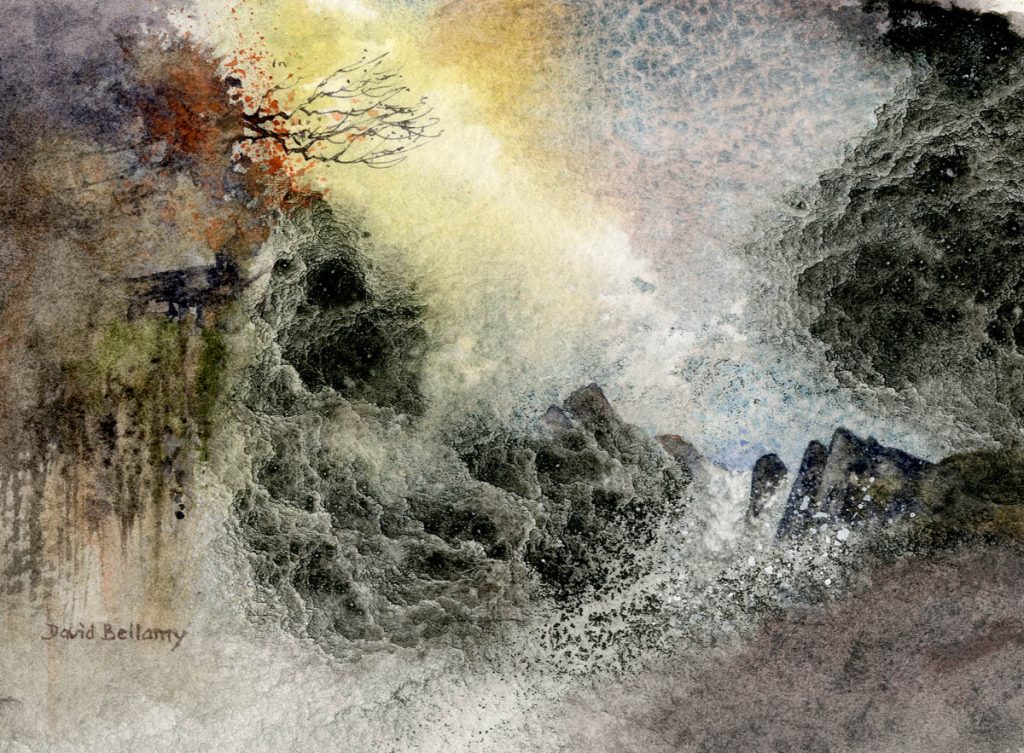
With modern super-granulating colours you can now introduce some amazing effects into your watercolour landscapes, and experiment with abstract passages to create interesting results. In this scene from my new book, Watercolour and Beyond, only a few motifs anchor the scene to reality: the hard shapes of the dark rocks; rocks detail in the top left; and the bush at the top.

The cascade of light was painted with sheer abandon, flowing in nickel titanate yellow and lunar blue into the upper section, then applying lunar black, both the latter two colours heavily granulating. I then immediately squirted copious amounts of granulating medium into the lunar black, using a pipette, varying the angle in places. Some of the rocks were painted wet-into-wet, while the more prominent ones were added once the paper had dried completely. The protruding bush was drawn with watercolour loaded onto the nib of a dip pen to achieve the very fine effect, and I completed the work with some spattering of white gouache on the bottom right to suggest spray, and transparent red oxide over the bush.

I painted this on Bockingford 200lb rough paper and the paints are the superb Daniel Smith Extra Fine Watercolours

Watercolour and Beyond is published by Search Press We no longer sell by mail order, but the book can be obtained direct from Search Press or any good book shop. It was great fun to write, with the emphasis on experimentation, and written to introduce a fun element into painting, while at the same time depicting some fascinating new techniques with watercolour painting. Henry Malt in Artbookreview.net says of the book: “What we have is, quite simply, his best book” I hope you enjoy it!