DAVID BELLAMY Painting Rock Features

Rock and cliff features are some of my favourites, not just in the mountains, but when painting coastal scenes. You can obtain truly striking effects of light on rocks and crags in the contrasts of light and shadows areas, and also colours are intensified wet rocks are caught in certain light or when they become wet, allowing you to introduce imaginative and creative responses.

In this composition high up on the Sundance Mountains of the Canadian Rockies I turned afternoon light into early evening by flooding the peaks with a transparent glaze of French Ultramarine and Alizarin Crimson, and deepening the shadows. Much of the rock surfaces I have left completely blank to increase the suggestion of strong light, while the shadow parts were painted with a weak mixture of French Ultramarine and cadmium red, then yellow ochre was floated in while it was still wet. When this had dried I drew in some fracture lines with a no. 1 rigger using French Ultramarine and burnt umber, applying more pressure to the brush in places to vary the width of the fractures.
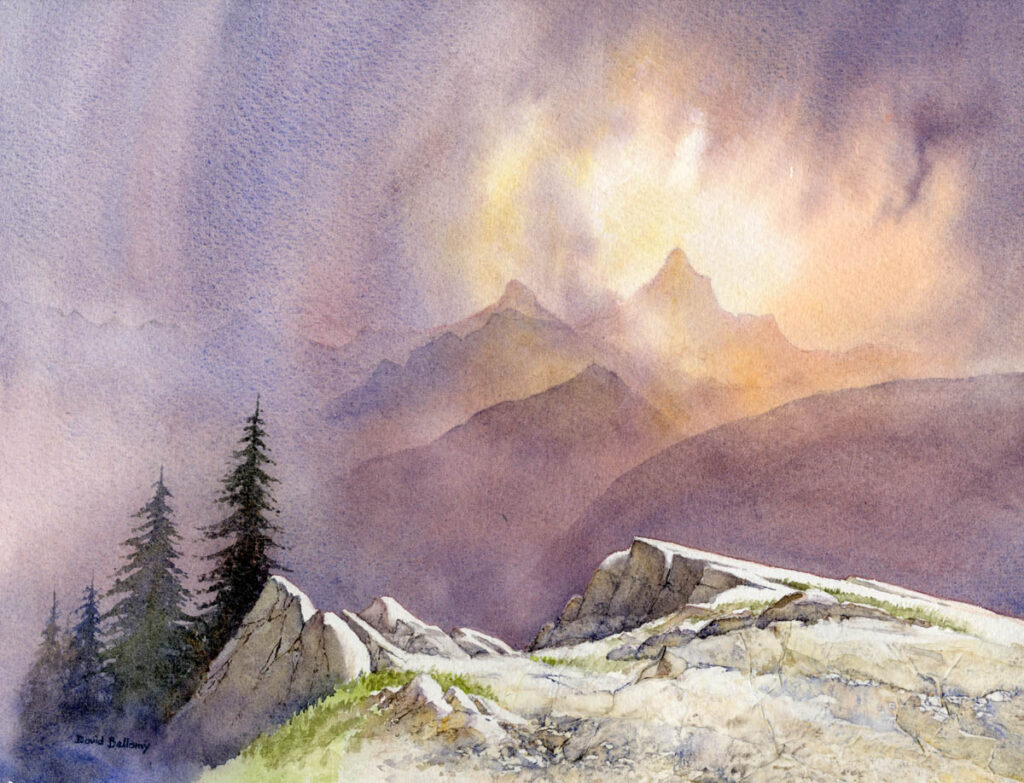
For the flattish foreground I glued tissue paper over the Saunders Waterford 200lb rough paper, which of course changes the response of a wash considerably. Tissue paper is quite useful for depicting rocks as it creates natural fractures when glued down, if you leave the crinkle ridges in place. I painted over it using the side of a large sable to further suggest textures, and for this I apply a very wet wash then follow it up by dropping other colour into it to cteate variations. This is one of the techniques from my book Watercolour and Beyond, which contains many techniques and devices I’ve not covered before.

I shall be carrying out a demonstration and workshop at https://internationalwatercolourmasters.com/events-new/david-bellamy-19-may-1-day-workshop/ the International Watercolour Masters event in Shropshire on 18th and 19th May and would love to see you there if you can make it.
David Bellamy – Observing the Landscape

Learning to draw and observe properly are essential skills for the landscape artist in watercolour, and although most artists can see objects clearly, so many have appalling problems when trying to observe and record a scene. This is one of the fundamental skills I try to teach students on my painting courses, but it does take quite some application and determination to continue practising the skills once the course has ended.

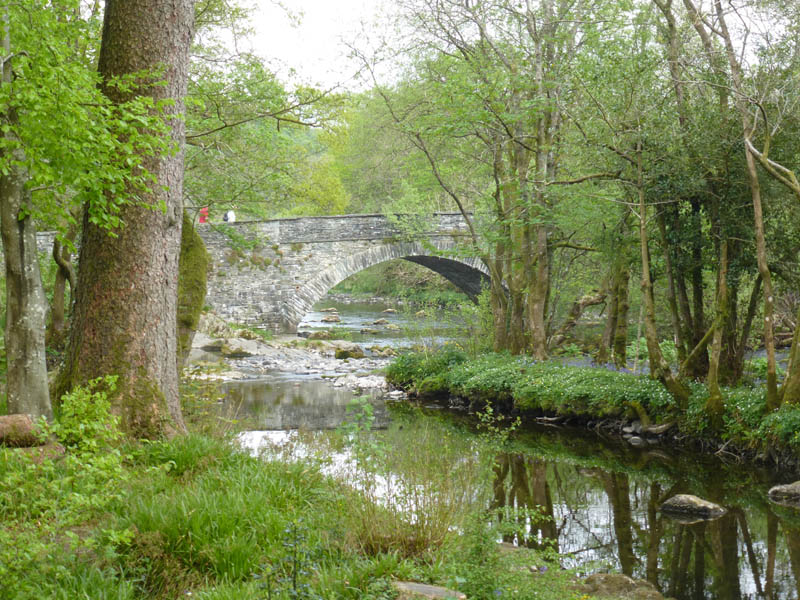
This is a photograph of Skelwith Bridge, taken during my recent painting course in the Lake District. Whilst the lighting is a little flat, it is still pretty clear that the distant features viewed under the arch are a little darker in tone than the left-hand side of the bridge, though they are lighter than the underside of the arch to the right. Comparison of tones in this way is a vital method of working out these tonal relationships. Always think not just about the shapes before you, but the main tonal relationships as well. This will bring forward your art in leaps and bounds, and I would urge you to practice this with deliberate emphasis for at least the next month or so.

My rough sketch of the bridge on the right was done in about 12 to 15 minutes and this is the sort of drawing that will help you with your tones. Breaking away from a pure linear response to a subject is absolutely essential in your development as an artist.

I shall be demonstrating at the Patchings Art Festival  on Thursday 9th, Friday 10th and Saturday 11th June, in the St Cuthberts Mill Marquee, painting on the fabulous Saunders Waterford and Bockingford papers. Do come and chat. It’s always a great show with superb demonstrators, marvellous crafts, paintings and art materials. I will be painting with Daniel Smith watercolours and will have available the dot-card palette of the colours I mostly use in their range, so come along and pick one up.

Demonstration

Brecon Beacons

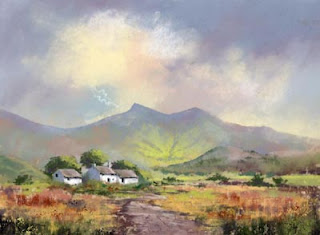
Brecons Beacons, pastel by Jenny Keal

I will be demonstrating pastel painting techniques at

Erwood Station Craft Centre

on Saturday 10th September 2011 between 1.00 p.m. & 4.00 p.m.

Click here for details

Above is the painting I did as a demonstration at the station in July.

Come along and enjoy the best coffee and cakes in Powys.

Jenny Keal Landscape painting demonstration

For those who love to paint landscapes and are keen to improve their work, they can do no better than to pop round to Erwood Station Craft Centre on Saturday afternoon (24th July) to see a demonstration by Jenny. She is one of the finest tutors on landscape painting around, and does an excellent demonstration. Unlike many demonstrators she paints a different subject every time and is eager to help students with their work.

While Jenny works mainly in pastel, a great deal of her advice applies to all mediums, so even if you work in watercolours, oils or acrylics, do come along and see her in action. She is also keen to help those artists who enjoy working in pastel, but find the pastel dust a problem – she has excellent techniques for coping with this, and is happy to answer your questions.

She will be at the centre from mid-day onwards and will be signing her new book. Her demonstration will begin at 2 pm, and you will be able to see her superb exhibition at the same time. Erwood Craft Centre is a lovely place to visit, not just for the paintings and crafts, but they do excellent teas and there is a lovely riverside walk along the Wye. Their telephone number is 01982 560674