
DAVID BELLAMY GLAZING A WATERCOLOUR FOR ATMOSPHERE

The glazing technique is an extremely powerful way of creating atmosphere in your landscapes, and is a method I use regularly. This involves laying a transparent or semi-transparent wash of watercolour over part of a painting that has already been painted. You need to ensure that the paper is completely dry before laying on the glaze, although if you are very experienced you can on occasion get away with laying it on a damp surface, although it is easy to end up with a mess in that case!
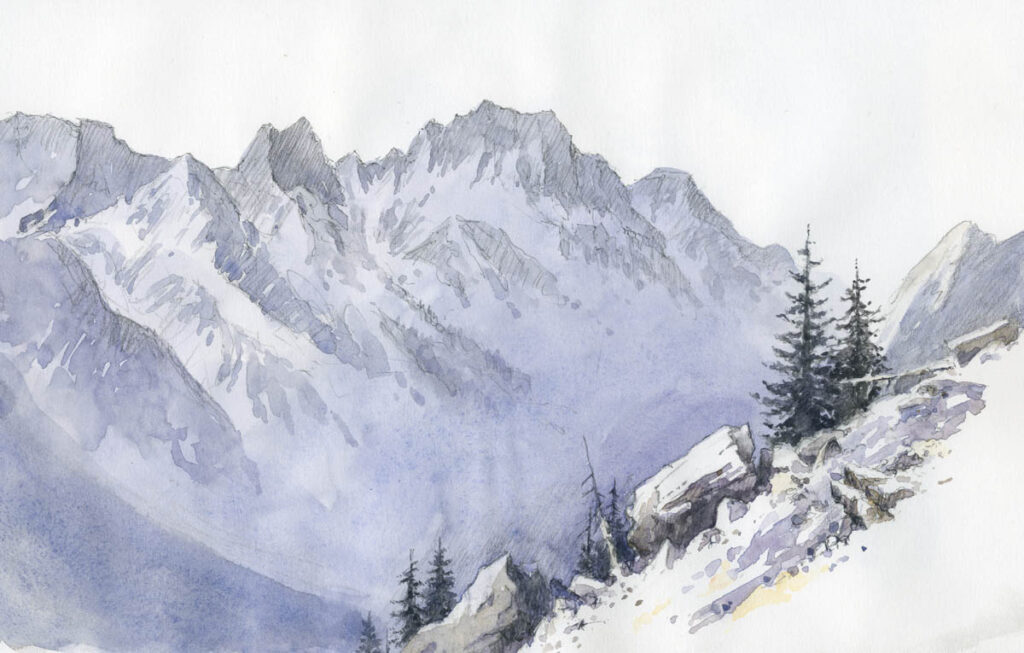
This is a watercolour sketch of a scene high up in the Sundance Mountains in the Canadian Rockies, painted in a cartridge A4 sketch-book, and is almost a monochrome. Throughout I’ve used a mixture of French ultramarine and cadmium red in various strengths of tone, firstly laying on a wash of a light version and when this had dried applying detail with a darker tone of the same mix to indicate the shadow areas on the peaks. When all the background detail had been painted I waited till it dried and then applied a glaze of the same mixture only making this darker above the large boulders and lightening it as it crept up the face of the far mountain. This softened some of the lower detail and created a sense of misty atmosphere in the valley below. I then completed the foreground detail on rocks and trees. This scene is featured in my Watercolour and Beyond book published by Search Press. It is packed with watercolour techniques and methods to enhance your paintings.

The glaze method can be used on all types of landscape, not just mountain scenery, and limiting the colours in this way further enhances the mood. With sharp contrasts in the foreground the sense of misty atmosphere is further enhanced. The technique is also great for warming up or cooling down a passage in your composition, or if you wish to highlight a particular part of it, such as a building, summit or other feature.

One extremely effective tip is to try this method out on an old watercolour, perhaps one that hasn’t really worked for you, so dig out some of you old painting and have some wonderfully experimental moments with them.
DAVID BELLAMY ADDING SUPER-TEXTURE TO YOUR WATERCOLOURS

Next month, my new book, Watercolour and Beyond is published by Search Press. It’s quite different from my earlier books in that although it begins with traditional techniques it is mainly concerned with introducing new methods to watercolour landscape painting. One example shows how to use masking fluid not just for masking out intricate details, but to employ it in a much more creative manner. Or producing delightful effects by stamping with cosmetic sponges and variegated colours. Super-granulating colours can achieve spectacular passages in your work, and by introducing non-art materials into your landscape compositions your can add a new dimension. There are also ideas for various projects, some of which don’t involve creating wall-hung art, but give you alternatives for your work.

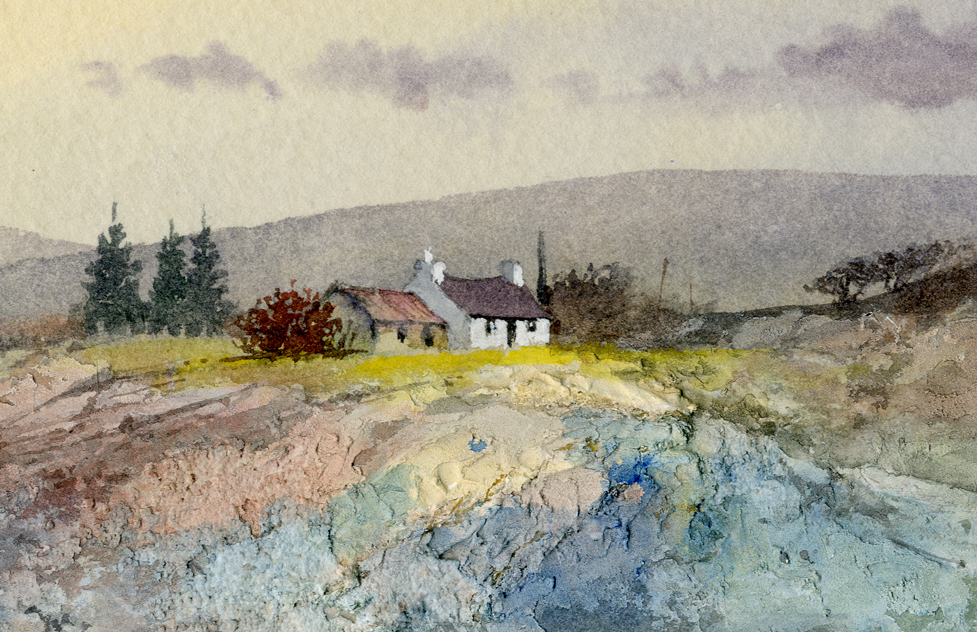
The painting I have chosen as an example from the book shows how a foreground can be embellished with Daniel Smith Watercolour Ground, which is rather like gesso in consistency, but it will happily take your watercolour washes. I have cut out a large part of the composition so that it’s easier for you to see the amazing textural effects you can achieve with this method.

To suggest the rough foreground Daniel Smith Watercolour Ground was laid on with a painting knife a couple of days before beginning the painting, and in the final stages I laid washes of Naples yellow, potters pink and pthalo blue over the watercolour ground, merging them all in while they were still wet. The ground is especially effective in rendering rocks, cliffs, rough walls, mountainsides, river banks and many other landscape features.

One of the main aims in writing Watercolour and Beyond was to encourage experimentation and bring a sense of joy into painting. Whether you paint full-time or just now and then you will find the techniques and ideas crammed into its pages will give you plenty of inspiration and a wonderful feeling of trying something new in your painting. We no longer have a mail-order shop, but of course you can get the book direct from www.searchpress.com or from your local bookshop.

On Saturday 3rd May the Erwood Station Landscape Artist of the Year competition gets under way with the first heat. There will be one heat each month throughout the summer, and if you wish to participate you can get information at 01982 560555. It is a great place to spend the day painting with others, and is a great learning experience. I shall be one of the judges during the first heat, so maybe I’ll see you there.

Eilean Donan Castle as a watercolour monochrome painting

Many inexperienced artists find that coming to terms with tones, colour mixing and the myriads of other complications with watercolour painting is so overwhelming that they almost feel like giving up. If you suffer from this syndrome then try working in monochrome for a while. This will greatly improve your tonal evaluation and get you back on the rails once more.

By using just one colour throughout the painting you can concentrate on getting the tones right and not have to concern yourself with any of that nasty colour mixing that confounds so many. As usual, build up the watercolour starting with the lightest tones and gradually bringing in the darker ones. Try a dark colour such as indigo, Payne’s grey, burnt umber or warm sepia, though I have to be in a truly bad mood to use the latter as it’s such a depressing colour.

The painting shown above shows the Eilean Donan castle in the Western Highlands of Scotland, which was featured in one of my very early books. It was carried out on tinted paper and is a lovely example of creating a landscape composition without resorting to colour. Monochrome also has the advantage of creating a sense of unity and mood. After a few monochromes try adding a second colour, gradually bringing in more colours once you feel more confident.

There is a useful section on monochrome painting in my paperback Learn to Paint Watercolour Landscapes available from http://davidbellamy.co.uk/