
DAVID BELLAMY: HAPPY CHRISTMAS

It feels very un-Christmassy here in rain-drenched Pembrokeshire at the moment while I’m recovering from a fairly mild dose of ‘flu, and I’ll need to be in top form next week when my two over-active grand-daughters arrive. Jenny will be safely ensconced in Hampshire with her ‘little’ ones while I face the full force of furious chaos.

A fall of snow would help of course, with the distraction of building a snowman while I sneak in a quick watercolour sketch if I’m lucky. Plotting it is fairly easy as I can take the girls up handy toboggan slopes at the same time and where the mountains are in full view. The attached watercolour of the Black Mountains gives an idea of what can be done reasonably quickly. In cases like this where speed is vital then watercolour pencils are truly effective.
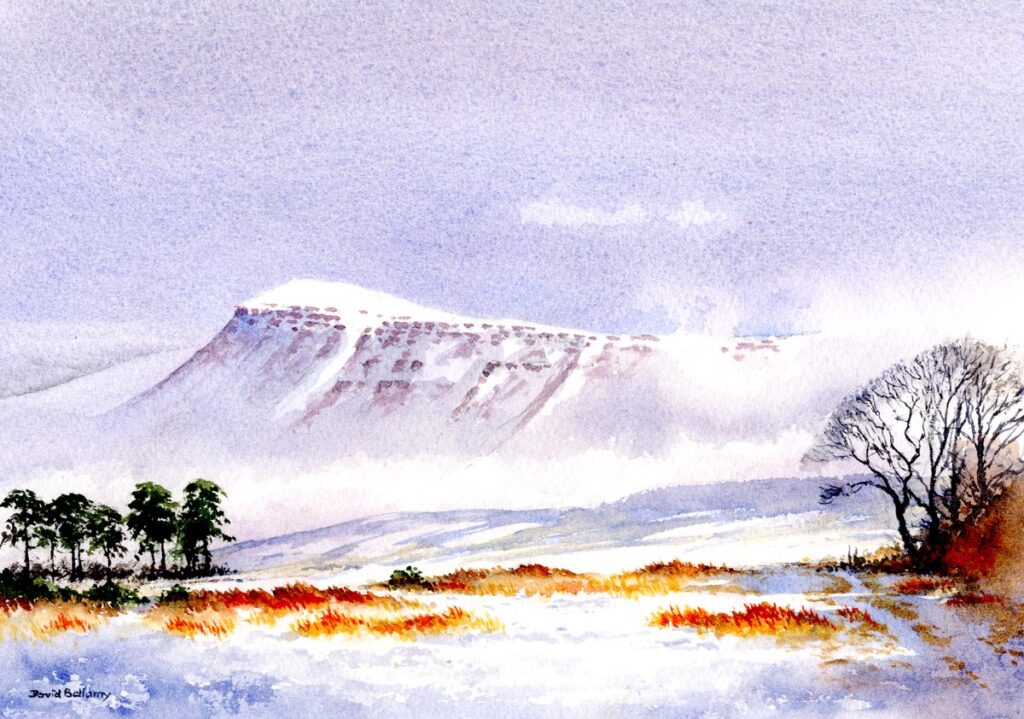
Note how the track on the right-hand side has been defined in the snow with intermittent stabs of the brush to suggest a winding effect. For this I used transparent red oxide, and also floated it into the dark mass under the trees while this was still wet. The background at this point has been kept simple with just a stroke or two of a wash brush, and the mountain ridge at the top has been lost in cloud in places. These are all really simple techniques which use the watercolour medium to advantage. This has been painted in the studio on Saunders Waterford 140lb NOT paper, but in a sketch these effects can be achieved in two or three minutes with watercolour pencils, working freely without any need to create a complete landscape composition.

Enjoy your Christmas and have a great time. I wish you every happiness for Christmas and 2026 and evry success with your painting.
DAVID BELLAMY: THE MAGIC OF WINTER TREES

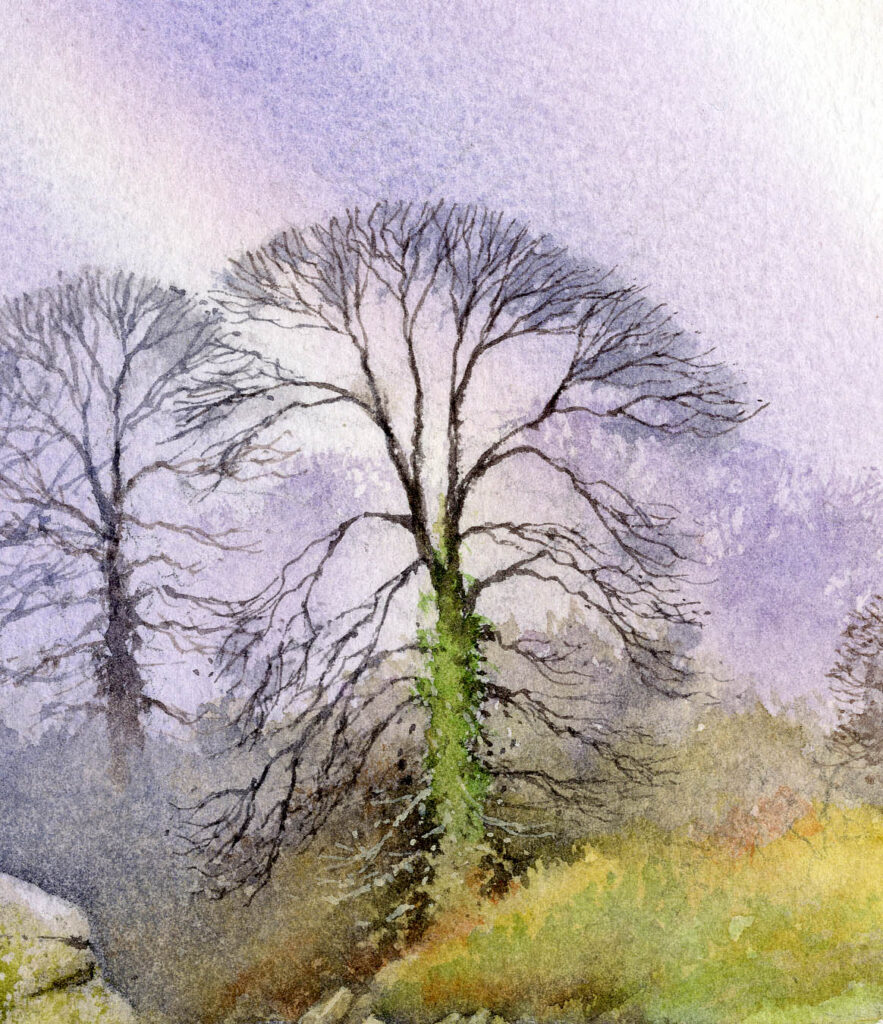
The sight of a beautiful mature winter tree can bring such joy, and spending a little time ensuring your trees bring out those magical feelings is well worthwhile. When I come across a fine example I sketch and photograph the tree from different angles, and in the studio I keep these in a support file which is a reservoir of landscape features that I can add to a scene I am working on, or substitute for some blasted and tattered beanpole of an excuse for a tree that might be present in a scene.

These trees are part of a composition, and as you can see the supporting tree on the left has been left almost as a monochrome, while fading it out at the bottom, two effective methods of pushing it into the background. More colour has been brought into the trunk of the main tree, and this is something important to observe in a mature winter tree. The green apatite genuine in the middle section of the trunk gives way to light red near the bottom, while higher up against the light background the trunk and branches become silhouettes. The dark background bushes define the lower trunk and some of the thin branches have been created by scratching with a scalpel when the paper had dried. Watch for the character of the branches in your trees, and here you see how they have been drawn with a sinuous downward looping, apart from the topmost branches. The finer ones were achieved with a no. 1 rigger brush. I used Daniel Smith watercolours and Saunders Waterford not high-white paper.

Seek out these lovely examples and study the trunks in particular. I sometimes work more detail into really exciting trunks, and in Radnorshire we have some fabulous trees, so deliciously twisted and gnarled that you expect some witch to fly out of the branches. There are many examples of trees in my books: my Complete Guide to Landscapes is packed with them, and you can easily obtain them from Search Press.

I shall be giving a demonstration of winter trees in watercolour at Erwood Station Craft Centre on Saturday 1st November. This will include showing how to use a tree as a focal point, adding in supporting trees, suggesting distant trees, enhancing trees with colour, avoiding the silhouette effect, and so much more. Tickets are available at www.evenbrite.co.uk and if you need further information Erwood Station can be contacted on 01982 560555 Proceeds from the event will be donated to MidWales Mind charity. Bring a notebook, camera and any questions you may have.

Another demonstration that is open to all will be at the International Watercolour Masters 2026 at Lilleshall Hall in Shropshire on 18th May 2026. You can book my session there now at www.iwm2026.com

David Bellamy – Painting sheep and lambs in springtime

 The onset of spring nearly always gives us all a sense of hopeful anticipation of more pleasing times to come, perhaps more so this year than ever before as we attempt to recover from this dreadful virus. I hope you are able to get outside and take advantage of the better days, and perhaps manage a sketch or two. For me, daffodils always make a powerful foreground feature, and it’s worth capturing some images of these while you are out.

     This image is part of a painting depicting lambs in early spring. Sheep are relatively easy to draw, but can pose problems for the unwary at the painting stage, especially where you have a light-coloured field caught in sunshine: you need a slightly darker area behind the sheep so that it stands out, and as you can see in this painting I have included several darker patches of grass in order to highlight the sheep. Generally I use Naples yellow for the main body, often leave a white top on head and body to accentuate the sense of light. This is normally left as white paper, but touching in a little white gouache can help rescue one that has not quite worked.

    When including lambs it is important to put across a sense of the relationship between mother and lamb, or between a number of lambs enjoying each other’s company. This makes it look so much more natural. Compare the lamb by its mother in the foreground with the one on the distant right which is lying on it’s own. The closer couple invoke a much more pleasing composition.

    One of the stronger background features is the gate. Although this has nothing to do with springtime I mention it because it is a good example of negative painting. Here, I have worked the darker colour around the gate and posts to define the light woodwork. I never include all five or so bars as it’s good to keep some hidden in the long grass! The painting was done on Saunders Waterford NOT 140lb paper.

    Enjoy springtime, and you can find more help on seasonal work in my book Landscapes Through the Seasons in Watercolour, which you can obtain as a signed copy from my website www.davidbellamy.co.uk

David Bellamy – BRINGING WARMTH INTO YOUR SNOW LANDSCAPES

I’ve just returned home from doing some staged paintings in the studios at Search Press. They are aimed at the next book which is about landscapes through the seasons. More on that before long. It’s been a truly busy autumn, so busy that I was only able to squeeze in one trip, a visit to the Cinque Terre in Northern Italy, where I managed quite a number of sketches despite appalling weather for much of the time.

There have been so many demonstrations and workshops that my own work has had to be put aside for a while, but at least I might do some of my own painting over Christmas – painting is like a disease, I just have to keep throwing the paint around!

 Hopefully we’ll have some snow at some time, when we can get some new subjects. How it changes the landscape, so be ready to go forth with paints and camera – it might not last long.

The watercolour shows Pen-y-fan, the highest peak in the Brecon Beacons, which is currently on show at the Ardent Gallery in Brecon Tel 01874 623333 (the painting, that is, not the mountain!) I sketched it in colour during the middle of the day a few years ago, but felt it needed more colour, so I added a warm, evening sky and heightened the warmth of the vegetation and on the central tree. It’s always a good idea to add some colour to a cold scene if you can manage it.

 Have a great Christmas and I wish you much success with your paintings in 2020

Painting misty ice-rimed trees

We have a lot of mud in Wales, and this winter it has excelled itself, making hiking something of a messy process, so it would be a pleasant change to see some good clean snow for a change. Then back to mud, of course.

I love those misty mornings with the sun beginning to filter through. It’s worth finding a local river scene on these mornings as they lend themselves well to this sort of atmosphere. This scene shows only part of the composition, and I have applied masking fluid at the top of the birch trees to accentuate the hard edges of the ice-rimed branches. When this had dried I worked in the background wet-in-wet to create a soft, misty effect, and this included the distant trunks and branches. It was an intensely cold morning. I have washed in Naples Yellow into the right-hand sky area and into the birch trees to add a sense of warmth, as well as in the reeds. The water was again achieved wet-in-wet – note how the bank below the birches has a slightly darker reflection than the bank itself.

This is taken from my Winter Landscapes book which is crammed with ideas for painting winter scenery, even if you have no intention of going outside to take full advantage of all that glorious mud!!!