David Bellamy – Painting figures in a mountain landscape

Including figures in a landscape painting is one of the most basic ways of suggesting a sense of scale, but in a vast landscape where do you position them, and how large should they be? These can be critical decisions for the artist, especially as figures tend to immediately attract the eye of the viewer. They therefore become the focal point.

In this large watercolour of Gyrn Las in Snowdonia the two figures are barely discernible in such a small reproduction. They are actually standing at the top of the small stream descending to the right of centre in the lower part of the composition. Even in the original they are not obvious, but once you know they are there they impart a feeling of being completely dwarfed in an immense landscape. They could not have been painted much smaller without completely losing them, but had they been made much larger the scene would appear a great deal smaller.

The optimum position for placing figures is about one-third into the painting from either side and one-third from the top or bottom of the composition, but this can be varied to a degree, to suit the scene. Here they are a little less than one-third in from the bottom, but about one-third from the right-hand side.

This watercolour, and many other works can be seen in the Autumn/Winter exhibition “Harmony” at Boundary Art, Cardiff’s newest art space, where you can enjoy a Chinese tea while contemplating the exhibits which range from traditional to contemporary paintings in oil and watercolour by many artists. The exhibition runs from Saturday 14th November to 31st December. Boundary Art is at 3 Sovereign Quay, Havannah Street in Cardiff Bay, CF10 5SF  Tel. 02920 489869  Check out the website at http://www.boundaryart.com

David Bellamy – Sketching Alpine scenes in Watercolour

Some good folk may well manage to get out blogs while on a camel trek to Samarkand, but alas, when you are carrying all your art gear, a full china tea set and a spare rucsack full of Danish pastries it’s a bit much to include blogging devices as well. Hence the lack of blog posts – I’ve been out at the ‘sharp end’ for a few weeks, though staying at the superb Sunstar hotel in Zermatt was hardly roughing it. The staff were brilliant, providing that marvellous Swiss hospitality, though as I couldn’t get them to provide an after-dinner yodelling session the entertainment for the painting group with us was reduced to the notorious Bellamy’s Bedtime Stories.

   Unsurprisingly, this post therefore covers complicated Alpine scenery, which certainly challenged the painters. In this watercolour sketch of the Matterhorn from the Theodulgletschersee I chose this medium because I wanted to record the colours, many of which were quite extraordinary, especially in the rock band directly beyond the lake. Some of these were violent reds, looking as though they’d just erupted from the earth’s interior – a geologist’s heaven. I’ve also brought out some of the varied colour on the mountain itself, and it pays to look for these nuances in colour when the subject is before you.

The sketch looks complicated, is a little over-worked, but I was more concerned with getting plenty of detail for the finished painting which I will do later in the studio. Even then it is considerably simplified. By all means overload, overwork and over-write on your sketches, as they are a working document, and the main simplification should appear in the final painting. As the painting is usually larger than the sketch you can see why we need more detail than looks right on many sketches. There wasn’t a cloud in the sky but I added one to break up the harsh lines of the mountain to show students a useful device. We had blazing hot sunshine every day so where there was no shade sketching proved quite a challenge when presented with all that glaring white paper, and the consequent difficulties in assessing tonal values.

This autumn I have another of my watercolour seminars in Great Bookham near Guildford, which coincides with my next exhibition in the Lincoln Joyce gallery just across the road. The Old Barn Hall in Great Bookham is a fine venue and my theme this year is painting animals and birds in the landscape.

Over the years wildlife has given me such great pleasure, sometimes great hilarity and occasionally a few scrapes. The first session is a painting demonstration, and after a break for refreshments it will be followed by an illustrated talk which will include British landscapes with farm animals, birds and wildlife, plus many wildlife scenes from the Arctic, Africa and other places. This will cover animals in some detail and those that are hardly visible or in the distance, and how to include them in your composition. Birds will tend to be less detailed by comparison. Naturally, there will be a variety of scenery, skies and atmosphere. For more details please check out my website  Tickets can be obtained from the website or from Lincoln Joyce Fine Art (Tel 01372 458481) Both sessions will be packed with techniques and wild experiences, so do come along and join in the fun.

David Bellamy – Painting rough ground in watercolour

My work tends to gravitate to those places I love most – the mountains, the wild coast and remote places where nature is supreme, where the ground is generally pretty rough. Capturing this roughness in a painting can be very rewarding, and as rough ground is not found only in the wild areas it pays to be able to render this effectively.

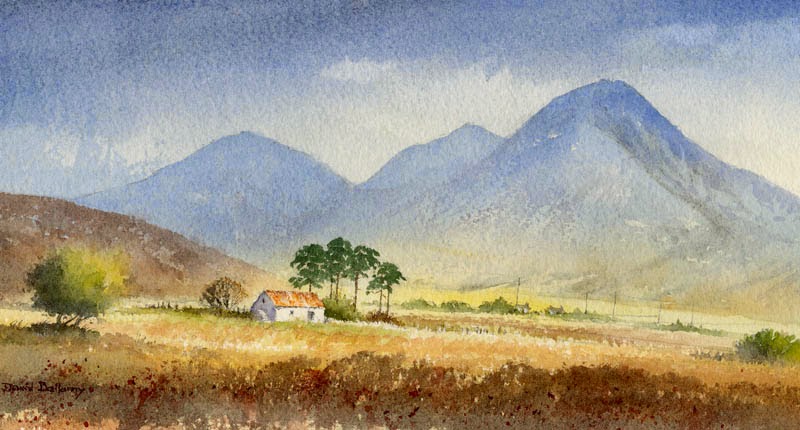
In this watercolour of a barn on the Isle of Skye rough terrain dominates the scene. I chose Saunders Waterford rough 140-lb paper which works so beautifully when you wish to create these fascinating rough textures, and effectively does half the work for you. With the highest mountain I began with an overall wash of Cobalt blue, bringing in some yellow ochre near the bottom in a soft graduation. When all this was dry I then used a stronger mixture of the blue with little water on the brush, dragging it down in the direction of the slope to produce an overlaid wash of broken colour which allowed some of the previous wash to show through, thus creating the appearance of rough ground on the mountainside. I employed the same technique on the warm-coloured left-hand hill, making the contrast between the first and second applications much stronger than those on the mountain because the hill is so much closer. In front of the barn I’ve used a combination of drybrush and dabbing on a warm colour to suggest the rough grasses, over an initial wash of Naples yellow. You can apply this broken colour technique in many situations, but for rough terrain it is ideal.

This painting will be displayed in my forthcoming exhibition at the Windrush Gallery in Windrush, Gloucestershire OX18 4TU  Tel. 01451 844425 from Sunday 3rd to Sunday 10th May. Please note it will be limited opening on 7th and 8th May during a workshop. Opening hours are from 11am to 5pm The exhibition covers a wide range of subjects, including mountain, marine, pastoral and several overseas paintings.

David Bellamy – Reserving whites in a watercolour

One of the greatest problems concerning the watercolourist is that of reserving whites in a painting. There are several ways of tackling this: the use of the negative painting technique, masking fluid or film, scratching with a knife or scalpel, or the use of Chinese white, white gouache or acrylic. Pulling out colour with a damp brush or tissue, or sponging out when the wash is dry, are further ways of achieving a considerable lightening of the tone, although these latter methods rarely are as glaringly white as the aforementioned ones. Down the centuries white body colour has been employed, the equivalent of our white gouache or Chinese white.

These days even the main watercolour societies feature paintings carried out with much use of white gouache or acrylic paint, so there is no stigma attached to using that method, and I shall illustrate it in a future blog. Scratching can be effective for minor features such as ropes or rigging in a harbour, limited sparkle on water, and similar items, but for larger or more intricate work masking fluid or the negative painting technique is a better method.

In the watercolour on the right I applied masking fluid over the actual icefall with all its complexities, in the positions where you see the absolute white. This, of course, is the naked paper after the masking fluid has been removed near the end of the painting. For the snow lying on the peak and crags, and also for the light cloud, I used the negative painting method, that is, I worked round the white shapes with the darker sky, the rocks and shadow areas. When it was all dry I applied further shadow washes using French ultramarine and cadmium red over some of the snow and rock areas that were in shadow. I could have employed masking fluid to some of these parts, but it results in hard edges and much of the edges there I wanted to appear soft, especially the light cloud. I find it best not to mix the two techniques in the same area as it can get confusing, thus causing errors, so I have deliberately kept the top and bottom halves of the composition apart in that sense.

This is one of the paintings that will appear in my exhibition at the Windrush Gallery from 3rd to 10th May (it will be closed on 7th and 8th May), at Windrush, Gloucestershire, OX18 4TU  Telephone 01451 844425 The gallery open times are from 11 am to 5pm daily. The exhibition will cover a wide variety of scenery, including marine and pastoral paintings. I shall also be doing a watercolour demonstration Painting in the Cooler Months in Windrush village hall on Saturday 9th May at 2pm. If you wish to come along please book in advance:  j.neil299@btinternet.com or phone 01451 844425

David Bellamy – Painting misty mountains in watercolour

Jenny and I have just returned from Austria where we took a group to paint Alpine scenery. It was a great trip, with many memorable scenes, despite rather a lot of cloud and mist. So we had rather a lot of practice in rendering misty mountains in watercolour!

Here I’m doing a watercolour demonstration way above the clouds, with marvellous views all round as the mountains rise out of the inversion. Alas, there were even more clouds above us, so we did get a little rain near the end of the demo, but not enough to spoil things. A cappuccino and an apple-strudel quickly restored morale.

Mist on mountains can, for the artist, sometimes be both magical and a misery. I love the way it can blot out unwanted features, but as we all know, it often blots out the very features we want to see!

There are a number of ways of creating mist in watercolour. In this scene above the Inn Valley in Austria I ran colour into wet areas to create soft edges to the clouds. I had to work quickly as I was painting on a cartridge book. With such a lot of cloud edges, inevitably some dry hard-edged before they can be corrected.

This is not usually a problem as they can later be softened with a damp brush when the paper is completely dry, though the odd hard edge here and there might well enhance the clouds.

Alternatively a soft sponge is an excellent tool for softening off, but take care if you use cartridge paper as it won’t stand too much surface friction. Enjoy your clouds!