DAVID BELLAMY GLAZING A WATERCOLOUR FOR ATMOSPHERE

The glazing technique is an extremely powerful way of creating atmosphere in your landscapes, and is a method I use regularly. This involves laying a transparent or semi-transparent wash of watercolour over part of a painting that has already been painted. You need to ensure that the paper is completely dry before laying on the glaze, although if you are very experienced you can on occasion get away with laying it on a damp surface, although it is easy to end up with a mess in that case!
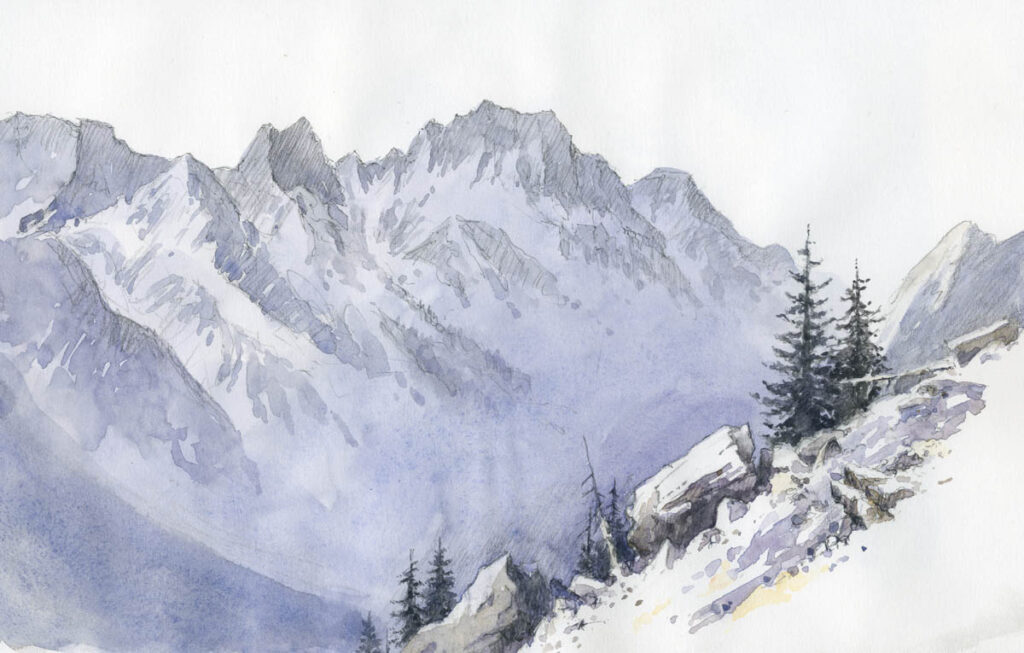
This is a watercolour sketch of a scene high up in the Sundance Mountains in the Canadian Rockies, painted in a cartridge A4 sketch-book, and is almost a monochrome. Throughout I’ve used a mixture of French ultramarine and cadmium red in various strengths of tone, firstly laying on a wash of a light version and when this had dried applying detail with a darker tone of the same mix to indicate the shadow areas on the peaks. When all the background detail had been painted I waited till it dried and then applied a glaze of the same mixture only making this darker above the large boulders and lightening it as it crept up the face of the far mountain. This softened some of the lower detail and created a sense of misty atmosphere in the valley below. I then completed the foreground detail on rocks and trees. This scene is featured in my Watercolour and Beyond book published by Search Press. It is packed with watercolour techniques and methods to enhance your paintings.

The glaze method can be used on all types of landscape, not just mountain scenery, and limiting the colours in this way further enhances the mood. With sharp contrasts in the foreground the sense of misty atmosphere is further enhanced. The technique is also great for warming up or cooling down a passage in your composition, or if you wish to highlight a particular part of it, such as a building, summit or other feature.

One extremely effective tip is to try this method out on an old watercolour, perhaps one that hasn’t really worked for you, so dig out some of you old painting and have some wonderfully experimental moments with them.
DAVID BELLAMY: HAPPY CHRISTMAS

It feels very un-Christmassy here in rain-drenched Pembrokeshire at the moment while I’m recovering from a fairly mild dose of ‘flu, and I’ll need to be in top form next week when my two over-active grand-daughters arrive. Jenny will be safely ensconced in Hampshire with her ‘little’ ones while I face the full force of furious chaos.

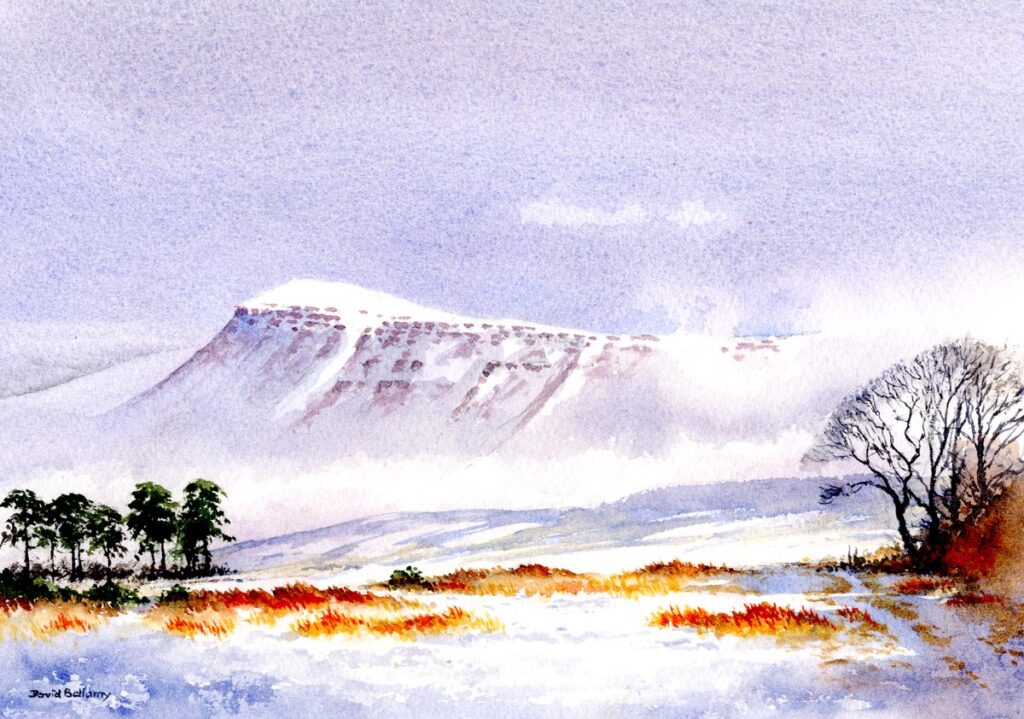
A fall of snow would help of course, with the distraction of building a snowman while I sneak in a quick watercolour sketch if I’m lucky. Plotting it is fairly easy as I can take the girls up handy toboggan slopes at the same time and where the mountains are in full view. The attached watercolour of the Black Mountains gives an idea of what can be done reasonably quickly. In cases like this where speed is vital then watercolour pencils are truly effective.

Note how the track on the right-hand side has been defined in the snow with intermittent stabs of the brush to suggest a winding effect. For this I used transparent red oxide, and also floated it into the dark mass under the trees while this was still wet. The background at this point has been kept simple with just a stroke or two of a wash brush, and the mountain ridge at the top has been lost in cloud in places. These are all really simple techniques which use the watercolour medium to advantage. This has been painted in the studio on Saunders Waterford 140lb NOT paper, but in a sketch these effects can be achieved in two or three minutes with watercolour pencils, working freely without any need to create a complete landscape composition.

Enjoy your Christmas and have a great time. I wish you every happiness for Christmas and 2026 and evry success with your painting.

DAVID BELLAMY ADDING SUPER-TEXTURE TO YOUR WATERCOLOURS

Next month, my new book, Watercolour and Beyond is published by Search Press. It’s quite different from my earlier books in that although it begins with traditional techniques it is mainly concerned with introducing new methods to watercolour landscape painting. One example shows how to use masking fluid not just for masking out intricate details, but to employ it in a much more creative manner. Or producing delightful effects by stamping with cosmetic sponges and variegated colours. Super-granulating colours can achieve spectacular passages in your work, and by introducing non-art materials into your landscape compositions your can add a new dimension. There are also ideas for various projects, some of which don’t involve creating wall-hung art, but give you alternatives for your work.

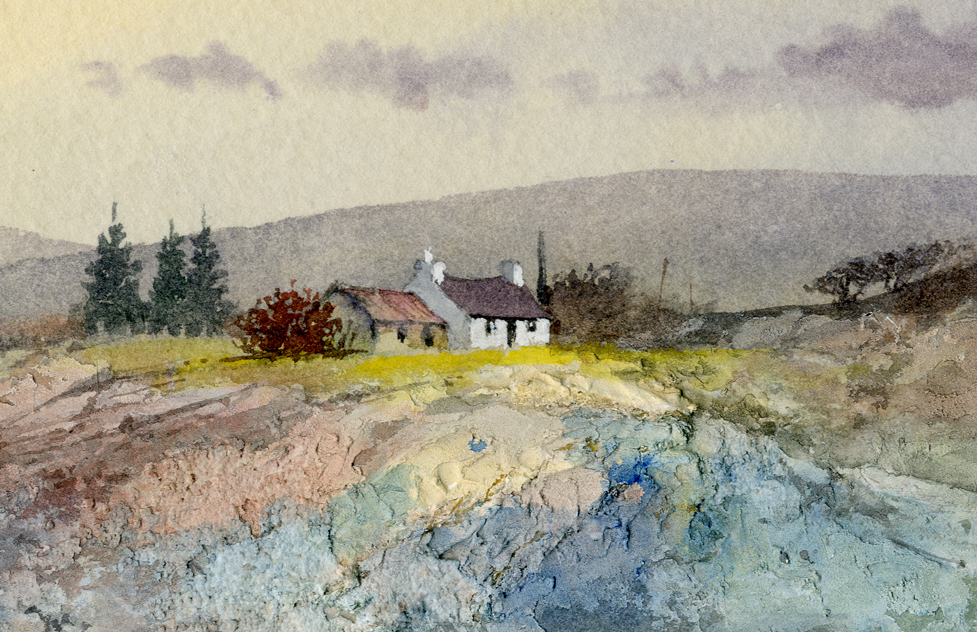
The painting I have chosen as an example from the book shows how a foreground can be embellished with Daniel Smith Watercolour Ground, which is rather like gesso in consistency, but it will happily take your watercolour washes. I have cut out a large part of the composition so that it’s easier for you to see the amazing textural effects you can achieve with this method.

To suggest the rough foreground Daniel Smith Watercolour Ground was laid on with a painting knife a couple of days before beginning the painting, and in the final stages I laid washes of Naples yellow, potters pink and pthalo blue over the watercolour ground, merging them all in while they were still wet. The ground is especially effective in rendering rocks, cliffs, rough walls, mountainsides, river banks and many other landscape features.

One of the main aims in writing Watercolour and Beyond was to encourage experimentation and bring a sense of joy into painting. Whether you paint full-time or just now and then you will find the techniques and ideas crammed into its pages will give you plenty of inspiration and a wonderful feeling of trying something new in your painting. We no longer have a mail-order shop, but of course you can get the book direct from www.searchpress.com or from your local bookshop.

On Saturday 3rd May the Erwood Station Landscape Artist of the Year competition gets under way with the first heat. There will be one heat each month throughout the summer, and if you wish to participate you can get information at 01982 560555. It is a great place to spend the day painting with others, and is a great learning experience. I shall be one of the judges during the first heat, so maybe I’ll see you there.

DAVID BELLAMY: PAINTING ICESCAPES

Featured

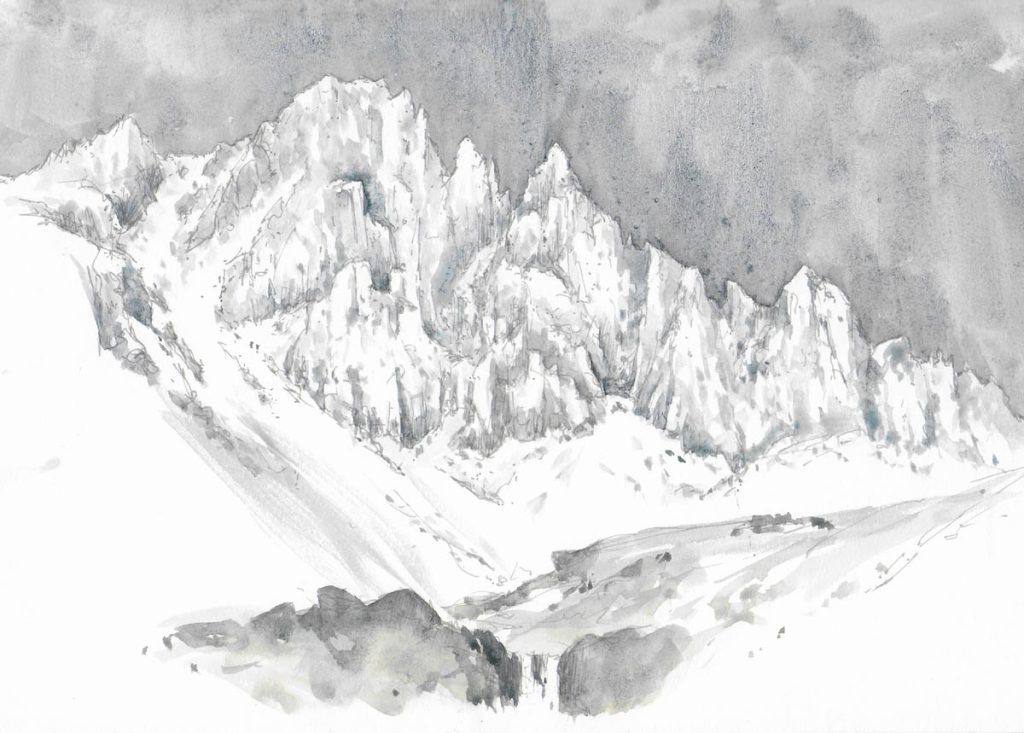
After five days of gloomy weather in the mountains of Snowdonia last month I decided I just had to go for the subject that was my prime target this time, whatever the last day threw at me. I aimed to climb up Cwm Tryfan to a spot where I could sketch Bristly Ridge, and hope the view was clear when I arrived. The light started well, but deteriorated to the murky mich-mash it had been all week. Plastered in thick ice, the east face of Tryfan gave me hope that my target scene would be likewise, but just being on the mountain gave me such joy, and fired me to do several sketches on the way up.

When Bristly Ridge eventually hove into view it took my breath away. Although I was familiar with the face and had climbed it in ice-rimed conditions, it presents an awesome spectacle, especially after many days of icy easterly blasts. I moved to a position where an attractive cascade and brook offered a superb lead-in and then sat on a friendly nearby rock to sketch in an A4 book. Unfortunately my position was rather exposed to that useful but hostile easterly that still blasted away, but initially the effort of getting up there kept me warm.

The poor light made observation of much of the rock architecture almost impossible to make out, but the ridge outline stood out well, as did the main gullies. I began with a grey pen, quickly drawing in the main features, well aware that I needed to work fast. As the temperature hovered around the freezing point the washes of French ultramarine with a touch of lunar black worked well without freezing up. I inserted the more prominent features first, working right across the composition, then applying a more impressionist style to suggest the lesser important crags and gullies.

A cuppa revivied me but the cold really began to penetrate so I dotted in a couple of climbers some two-thirds of the way up the left-hand slope but could not see the third one at the time. Then I hurriedly included the cascade and rocks, though did not have enough paper left to do a proper job. This is just a basic rendering of the scene, but in a painting I would bring it to life with creative lighting, and not include quite so much detail, losing some with cloud or shadow.

This was something of a nostalgic return as I have had many wild adventures here, some of them extremely life-threatening, a fact that intensifies my love for this magical spot, one of the most impressive in the British mountains.

David Bellamy – Changing the mood in a landscape painting

I missed doing an intended blog last week as I had three short videos to produce in connection with the forthcoming Patchings Virtual Art Festival next week. It starts on July 9th which was the intended date for the original festival, and you can find information on www.patchingsartcentre.co.uk Of the other two videos I made, one was for Painters Online at  www.painters-online.co.uk  run by Leisure Painter and The Artist magazines, and this shows ten tips I’ve put together for landscapists, while the third one was for Search Press which you can find on  www.searchpress.com  and this features a number of my crazy anecdotes on sketching expeditions. All three videos are quite different and I hope you enjoy them.

 You’ve had to wait a little longer than intended for my version of Llyn Mymbyr, so here is my effort together with the two photographs shown in the earlier blog:

This is the original scene that shows afternoon light catching the Plas y Brenin Mountain Centre buildings on the far side of the lake. As some interesting crags dropped into the water to the right of this composition I wanted to include them in the painting and illustrate how I go about bringing two visual sources of reference together for one painting.

This is the shot of the crags to the right of the above view, though it’s in shadow, a common problem when we are working outdoors, but it’s easy enough to bring two prints together and even better when you have a sketch as well. Getting these to fuse together on a laptop for the purpose of showing you, however, is not so easy for a non-tech neanderthal……..

In my version I have reduced the buildings so that interest is focused on the craggy peak, Clogwyn Mawr, which I’ve featured in strong evening light, while bringing in some mist behind the line of trees. I often change the atmosphere of a scene completely, and that really is my main lesson here: you don’t need to paint the scene as you see it, but as you would like to see it. Try small versions as studio sketches before you make a start on the painting. There are so many different ways of tackling a scene with a variety of moods and seasonal changes. Enjoy your painting!